
Sorry for the missing translation! The uploader didn't provide an English description.
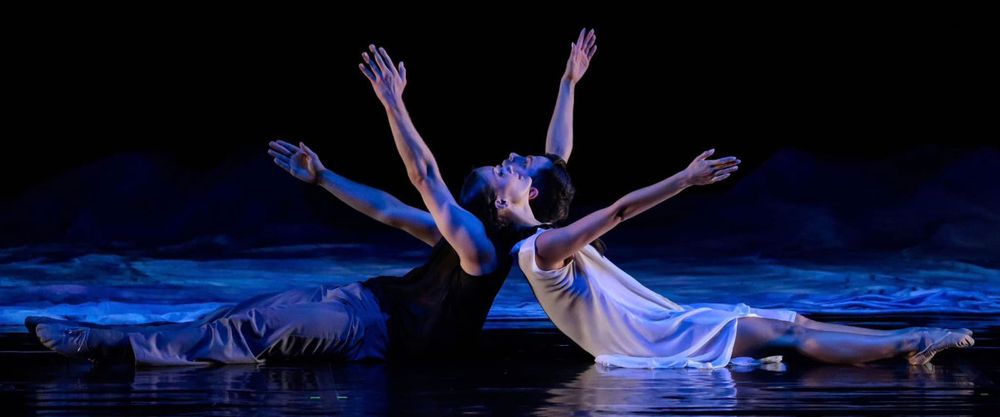
Fragment 24 | 45 // Prágai Kamarabalett | Lengyel Táncszínház
2026-02-20T18:00:00.000Z

Fragment
My Country is a cycle of six symphonic poems by the renowned Czech composer Bedřich Smetana, rooted in his love for his homeland. It is a celebration of the beauties of Czech nature, major national legends, and in part actual historical events as well.
But as is hinted by my production’s name itself, the aim here is not to go through Smetana’s entire work. My dramaturgy here only presents the parts for Vyšehrad (The High Castle), Vltava (The Moldau), and, presented in a small combination, Tábor and Blaník. In other words, 2 complete movements and 2 more largely compressed, i.e., 4. This brings us back to “24,” which is also a reference to the composer’s year of birth – 1824 – precisely two centuries ago.


Feb
20
Schedule
Smetana’s work was composed during the Czech National Revival: in an era that brought, among other things, efforts to increase national consciousness and self-determination. And Smetana felt this deep in his heart.
In our current age of advancing and all-pervading globalism, when many of these values are forgotten or relativized, when there is a clearly evident effort to fundamentally constrain national identities and states’ sovereignties in order to erase individual cultures’ historical memory, it is all the more necessary to return to these roots.
And to do so through more than just commemorating anniversaries and bowing to stone busts. This performance is all about tying in, about the principles and inner motivation of Smetana and other great names of the era, with whom we should come face to face through the artistic language of today, thereby keeping them alive…
My Country was composed almost in its entirety in the period in which Smetana was already entirely deaf. During the several preceding years, as the head of the Provisional Theater, he faced severe societal criticism, and often personal attacks as well. As he was pushed to his mental and physical limits, the last vestiges of his hearing abandoned him as well. Smetana withdrew from public life into his internal, quiet, yet creative world. It was there that the notes and tones of one of the most significant opuses in Czech musical history arose…
Smetana was given by the people of “his fatherland” several bitter chalices to drink. But behind the dignified pomposity of The High Castle along with that wise oracle, the princess Libuše, her sacred wedding with Přemysl the Ploughman, all the pagan rituals connected with this, the playfulness of the sources flowing together into the mighty River Moldau…, the choral music ringing through Hussite Tábor, and St. Wenceslas’ army riding out from Blaník to aid the nation… behind all of these stories, perhaps ineffable or even unbelievable today, there stands on the one hand the powerful archetype of national consciousness that is the Czech symbolic DNA, yet on the other also the “negligible” and fully authentic personal story of the artist – a man of flesh and blood.
All this is symbolism informing us that we need to perceive our roots, our culture, and our distinctiveness, without regard to our internal contentions, enmities, and all kinds of contemporary social “consensuses” and the horrors they often bring. And that from time to time in history, we all have to speak our words loudly enough, and if necessary, fight for them too…
We can find many examples among historical figures. We owe a debt to them that reaches both into the past and, above all, into the future, for our descendants and future generations.
45
A large-format show, written on the creations of dancers in the artistic language of Jacek Przybyłowicz. He draws on the physical intensity of contemporary Israeli dance, the elegance of neoclassical forms and the unfettered imagination of a contemporary dancer. A game with the rules of symmetry, decorative details, pastel tone, minimalism of costumes, finesse direction of light and an energetic duo of drums and saxophone create a tasteful composition. 45 is a non-linear story about the 45-year history of the theater. A collective portrait of young artists united by teamwork and the choice of art as a way of life.
Fragment 24
Performed by dancers of Prague Chamber Ballet
Choreography: Petr Zuska
Music: Bedřich Smetana
Artistic Director and Choreographer Assistant: Linda Svidró
Costume and set designer: Pavel Knolle, Petr Zuska
Lighting designer: Petr Zuska, Tomáš Průcha
Chief of technicians: Viktor Svidró
Light Engineer: Richard Šubrt
45
Choreography: Jacek Przybyłowicz
Music: Andrzej Konieczny, Kacper Krupa
Lighting designer: Carsten Wank
Costume designer: Joanna Klimas
Choreographer\\\\\\\\\\\\\\\\\\\\\\\\\\\\\\\\\\\\\\\\\\\\\\\\\\\\\\\\\\\\\\\\\\\\\\\\\\\\\\\\\\\\\\\\\\\\\\\\\\\\\\\\\\\\\\\\\\\\\\\\\\\\\\\\\\\\\\\\\\\\\\\\\\\\\\\\\\\\\\\\\\\\\\\\\\\\\\\\\\\\\\\\\\\\\\\\\\\\\\\\\\\\\\\\\\\\\\\\\\\\\\\\\\\\\\\\\\\\\\\\\\\\\\\\\\\\\\\'s assistant: Anna Krysiak
Location
National Dance Theatre
On 15 February 2019, Budapest's unique new cultural arena opened its doors: the new National Dance Theatre in Millenáris Park. The building, equipped with the latest theatre technology and featuring unique architectural solutions, offers two theatre halls and a chamber hall for dance lovers, as well as rehearsal rooms for professional dancers. The foyer of the building will also become a community space open to visitors to the park, giving Millenáris the opportunity to become even more part of the capital's bloodstream.
Similar Events
Telekom Spots is an open event listing platform where anyone can upload their own events for free. Telekom is not the organizer or sponsor of the events, unless explicitly stated for a specific event.