CSET FEST: Who were you, my daughter?

"Daydream.
Never so beautiful. The face ten years ago. The radiant Girl. The full set of teeth. The darkness of the eyes. The head thrown back a little, like an old magazine cover.
Coming down the forest path towards me. In a black corduroy coat, with springy steps. A gaze not yet hidden from all in the path of his own soul.
My daughter came towards me.
I held out my arms and called her name...
And my heart was painless.
She came so close that our faces touched.
And then, like a veil of tulle, the image faded, and I clung to my own face, and woke up saying, "Ouch!" Awake, and loud, I screamed: "You must know that you are the greatest and most hopeless love of my life, my daughter!"
(Mariann Csernus)

Schedule
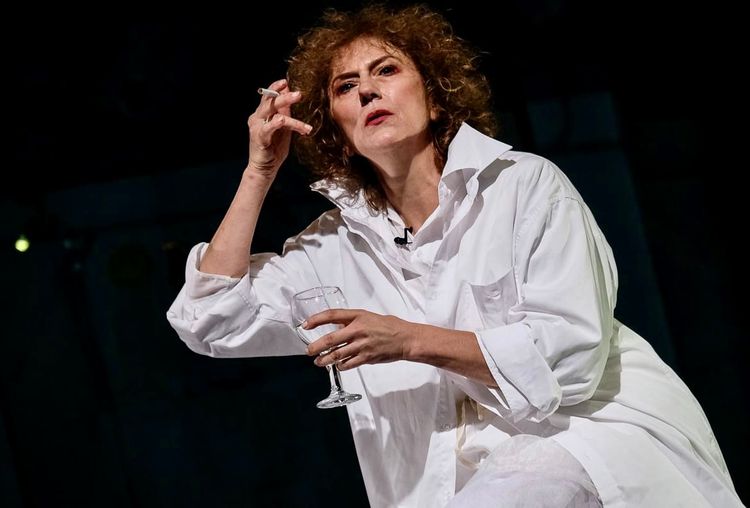
As an actress, Mariann Csernus (Kossuth Prize winner, Artist of Merit) has also had a long, hard-fought career embedded in Hungarian history.
She never graduated from college, and at the age of 18, in 1948, immediately after her graduation, she was engaged by Gábor Devecseri and István Egri at the Pest Theatre, and in 1950, at the invitation of Tamás Major, she moved to the National Theatre, where she remained a member until the end, and from 1989, a perpetual member.
He played a series of leading roles until 1962, when - after meeting his brother, who had emigrated during a trip abroad and who, as it turned out, was working for the American secret service - he was forbidden to appear on stage for a long time for political reasons, despite his brilliant talent. From then on, he toured the country with solo performances of Psyché, Déryné and The Bible of Bismarck, all of which were cultic productions of the period. In 1975 he returned to the National Theatre, where he remained after the name change (Pesti Hungarian Theatre).
Today he is 95 years old.
His daughter, Katalin Joó, also entered the acting profession (she graduated in 1975 in István Horvai's class), and then committed suicide at the age of 36 in shocking circumstances. Five years later, Mariann Csernus emerged from the silence of mourning with her book Who were you, my daughter?
This work is astonishingly intriguing and moving, but its genre is very difficult to define, a confession in fragments.
In writing that is always dramatically tense, she explores the motives behind her family tragedy with the stubborn, self-effacing honesty of a writer with respectable human self-discipline, already a 'female Oedipus', while descending deeper and deeper into the depths of tangled emotions. It is an imaginary dialogue with a dead girl.
It is the dialogue of a mother who knows, even unspoken, that it is impossible to understand, even to process, what has broken in the soul, using the tools of reason and understanding.
Yet she tries, she cannot help it.
Jurányi House
The Jurányi Production Community Incubator House has become a key venue in the capital's cultural life, a vibrant hub of the contemporary art scene.
Our aim in creating the Jurányi was to find a stable, shared home for the independent theatre and creative arts sector, providing the infrastructure necessary for its day-to-day operations. We wanted to create a cultural centre in the Buda area, a "contemporary art house" where theatre-loving young people could spend a few hours over a coffee or even a theatre performance, a creative children's activity or an acrobatic movement class, thus re-filling the abandoned educational institution with an active community life.
Jurányi is more than just a theatre in Buda, it is a creative and creative base where visitors can enjoy a varied artistic, community, and educational program, in addition to a regular repertoire of 300 productions a year. We are proud that the Jurányi House is now a graduation subject in some art schools.