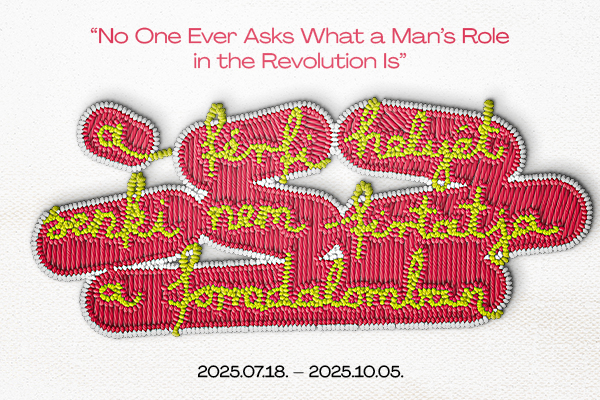
„No One Ever Asks What a Man’s Role in the Revolution Is”

A seventy-square-meter, floral-patterned carpet—originally created in the 19th century by more than 160 women—is moving from the storage of the Art Collection of the Hungarian Academy of Sciences into a contemporary exhibition space. This carpet is not merely a decorative object; it is a monument, a political statement, and a fabric-embroidered imprint of interwoven life stories.
The exhibition seeks to explore and share the history of the carpet, uncovering its layers of meaning and connecting it with other 19th-century and contemporary works, both Hungarian and international. The contemporary textile pieces on display not only reflect various forms of political expression but also embody the practices of artistic collectives.
The many points of connection between these works offer an opportunity to interpret textile through a non-linear narrative—one that traverses the realms of social and political positioning.
Schedule
Textiles stitch together, tear apart, interweave. The seventy-square-metre floral carpet made collectively by more than one hundred and sixty women in the 19th century now moves from the storage of the Art Collection of the HAS to a contemporary exhibition space. The carpet is more than mere decoration; it is a monument, a political statement and an imprint of intertwined life stories embroidered in textile.
Over the years, women have launched several community fundraising campaigns associated with the Hungarian Academy of Sciences, the institutional embodiment of the national idea and movement. One of the first of these was the making of the floral carpet between 1865 and 1867.
The Academy’s headquarters were inaugurated in 1865, but by the time the building was completed, money had run out and the interiors were left undecorated. This information was most likely brought to the attention of Mrs. János Bohus, née Antónia Szőgyén (1803-1890) in Arad, who launched a public call to the community in several newspapers for a carpet to be made for the Academy’s ceremonial hall. The carpet was completed by 1867 and brought to the Academy building, to take its place in the ceremonial hall first into a piece of furnishing, then as a decorative object representing the institutional authority across regimes and eras. The groups of women involved in the embroidery, counting over a hundred and sixty individuals, represented almost every stratum of society in terms of social class, denomination, age and marital status. The barriers to entry were the ability to sew and the purchase of a 75 x 75 cm unit to be crafted.
The exhibition seeks to delve into and disseminate the history of the carpet and explore its layers of meaning, interweaving them with other 19th century and contemporary Hungarian and international works. Not only do works of contemporary textile art represent different forms of political statement, but they also encapsulate the practices of different art collectives. The multiple points of intersection between the works allow us to juxtapose and interpret textiles in a non-linear narrative, from the perspective of spaces of social and political positioning.
It also attempts to present alternative art histories through the history of the carpet and the artworks and artefacts surrounding it, with a special focus on those never acknowledged or long forgotten 19th century handiworks that can be considered an integral part of Hungarian decorative or applied art. Institutional (self-)reflection may also come under scrutiny within the framework of the exhibition, especially in the light of the fact that the autonomy of the spaces of culture and science is being increasingly undermined – partly by privatisation and partly by unsustainability – or becoming intertwined with the powers that be. The gallery’s spaces are thus opening up to knowledge and academic works that have hitherto remained hidden, even though they carry considerable cultural-political weight. However, we must recognise that the carpet is impossible to present in its entirety and in the manner it deserves, not only because it is now cut into two pieces, but also because the spaces of culture are becoming ever so tight both symbolically and practically.
Exhibiting artists: Nearly two hundred, mostly female exhibitors, from the 19th century to the present day, such as Aubouin Adèle d'; Mrs. János Bohus, née Antónia Szőgyén; Catholics for Choice; Szidonia Deutsch; Mrs. Lajos Földváry, née Szita Aloyzia; Mrs. Count József Bethlen, née Sissányi Erzsébet; Lana Desastre Collective; Małgorzata Mirga-Tas; Marina Naprushkina; Sára Richter; Eszter Ágnes Szabó (HINTS); Sophie Utikal; Jakab Varjassy; Zapantera Negra.
Venue: Budapest History Museum - Budapest Gallery (1036 Budapest, Lajos utca 158.)
Date: 18/July/2025 - 5/October
Opening: 17/July/2025, 18:00. Opening speech: Emese Süvecz, art historian, one of the founders, executive director of Hungarian Women Fund
Curator: Anna Lujza Szász
Budapest Galéria
A Budapest Galéria a Főváros kortárs képzőművészeti kiállítótere. A galéria programja kéthavonta változó időszaki kiállításokból áll, amelyek érzékenyen reagálnak a város és a régió aktuális társadalmi kérdéseire. A kiállítási program egyaránt teret ad a fiatal, feltörekvő művészeknek első egyéni bemutatkozásukhoz és a középgenerációs alkotóknak praxisuk széleskörű megismertetéséhez, de a (főként) közép-európai fókuszú nemzetközi, tematikus csoportos tárlatokhoz is.