
Wing Maker | Exhibition by sculptor Pál Kő

Our commemorative exhibition also pays tribute to the rich oeuvre of the sculptor, who was active from the second half of the 20th century to the first decade of the 2000s, approaching it from a new angle: it highlights the important junctures of his oeuvre through small sculptures.
The exhibition is arranged in three rooms. The first room displays the earliest small sculptures, with which Pál Kő quickly became known after graduating from the College of Fine Arts. These sculptures were mainly made of wood, stone, and sometimes bronze. He often painted his wooden sculptures (Vision, Ring Grass, Big Blue Bird) or dressed them with pop art elements or everyday objects (Little Girl with Gold Earrings, Kossuth).
Schedule
The second room displays the mature artist's sculptures, which we have supplemented with photographic documentation of his public sculptures. Among these works, the most common type of sculpture is the portrait, and many small sculptures serve as sketches for public sculptures. The bronzes were made in the 1980s as sketches for sculptures of Hungarian poets (Kölcsey, István Sinka, László Nagy, Margit Szécsi), writers, composers (Bartók, Kodály), artists (Aba-Novák, Csontváry, Jankovics Marcell, Samu Géza) and kings (Béla III, Károly Róbert, Aba Sámuel). The sculptures placed in public spaces, depicting kings and figures from Hungarian history and public life, are generally smaller than life-size, and their pedestals play an important role, either elevating these medium-height sculptures or bringing them down to the viewer's eye level. This scale, resulting from the smaller-than-life-size form, makes these works much more accessible and easier to interpret. This room also houses sculptures created in recent years, but which, in terms of their approach, return to the characteristics of the early stages of the artist's oeuvre.
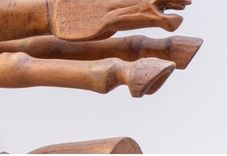
The last, third room displays the pieces created by Pál Kő for the Mohács Historical Memorial sculpture installation: the figures of Louis II, Suleiman, and Pál Tomori, with a large crossbow and a statue of a Turkish horse. These are complemented by small sculptures from the oeuvre that are related to the form and ideas of the Mohács sculptures, such as Táltos and Török ló. These are complemented by small sculptures from his oeuvre that are related to the form and ideas of the Mohács sculptures, such as Táltos and Szélhárfa.
The exhibition's creators aim to present an image of Pál Kő that focuses on the sculptor's works in a way that also takes into account the artist's own intentions.
Kunsthalle Budapest
The largest exhibition hall in Budapest, in Heroes Square, just the opposite the Museum of Fine Arts.