The aesthetics of error - Kinstugi workshop led by Dominika Pálinkás

Do you have a favorite porcelain object that has broken? Are you familiar with the kintsugi technique? Have you ever wondered why we don't repair our broken, damaged, or torn objects and relationships? Can you accept the idea of highlighting the cracks in broken porcelain rather than hiding them?
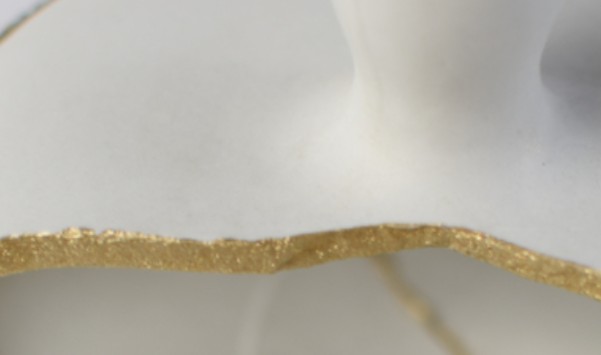
During the workshop, we will use the gold glue technique (kintsugi technique) on an object brought from home by the participants. Please bring a broken ceramic object of your own.
IMPORTANT: Participants are asked to bring a broken porcelain object to the workshop!!!
"Ceramics, and especially perfectly white porcelain, like glass, are very hard and durable materials, but they are also brittle and fragile. Therefore, it is almost inevitable that we will not be able to keep every piece intact during everyday use, so we simply discard the broken pieces. On the other hand, it is very painful when our favorite mug, a treasured unique cup, or an object received as a gift from someone dear to us falls victim to everyday life or a careless movement. I never throw away a single broken piece of pottery. Depending on my emotional attachment to the object, I either break it further and make a ceramic mosaic out of it, or I give it a new life using the kintsugi technique. In the latter case, the beloved object is preserved, but its function is transformed and, thanks to the gold, it takes on a higher level of aesthetics. Dominika Pálinkás
Schedule
What is kintsugi?
The technique of kintsugi originated in 15th-century Japan and was used to repair broken ceramic objects. The broken pieces were glued together with lacquer mixed with precious metal powder—mainly gold, but also silver and platinum—giving the object a new life and unique character. The gold on the surface highlights the cracks and increases the value of the object. This philosophical approach is called wabi-sabi, which emphasizes the imperfection, uniqueness, and transience of human life.
Maximum number of participants: 12 (We recommend participation for ages 14 and up!)
Workshop duration: 3 hours
· Introduction to the world of kintsugi (30 minutes)
· Familiarization with the works related to the exhibition Golden Repair - Fine Joints (30 minutes)
· Creation (2 hours)
Dominika Pálinkás, ceramic designer
She studied ceramics in high school and then continued her studies at the Department of Ceramics at the Faculty of Arts of the University of Pécs. After obtaining her master's degree, she completed her training as a design and visual arts teacher and then took up a position at the Gandhi Gymnasium in Pécs. At the same time, she completed a bachelor's degree in behavioral analysis at the Faculty of Humanities at the University of Pécs. She later began teaching at the University of Pécs's Ceramics Specialization. He is a doctoral student, and his thesis topic is the transparency of porcelain in porcelain sculpture.
For him, ceramics, pedagogy, and psychology form a triad, where the different fields exist in close connection with each other and interact dynamically.
Ludwig Museum
The Ludwig Museum - Museum of Contemporary Art, located in Müpa, is the first museum in Hungary to exclusively collect contemporary art. In addition to a permanent exhibition of the collection donated by the Ludwigs and a number of temporary exhibitions, the museum aims to raise awareness of the works and their creators through special publications and a variety of art education and art education programmes.