Survival Strategies IV. workshop with Zita Matulányi-Szabó

During the felting workshop, we will explore issues related to growing up, finding one's way, and the formation of identity with artist Zita Matulányi-Szabó, both on a personal and social level. A detailed workshop description will be available soon.
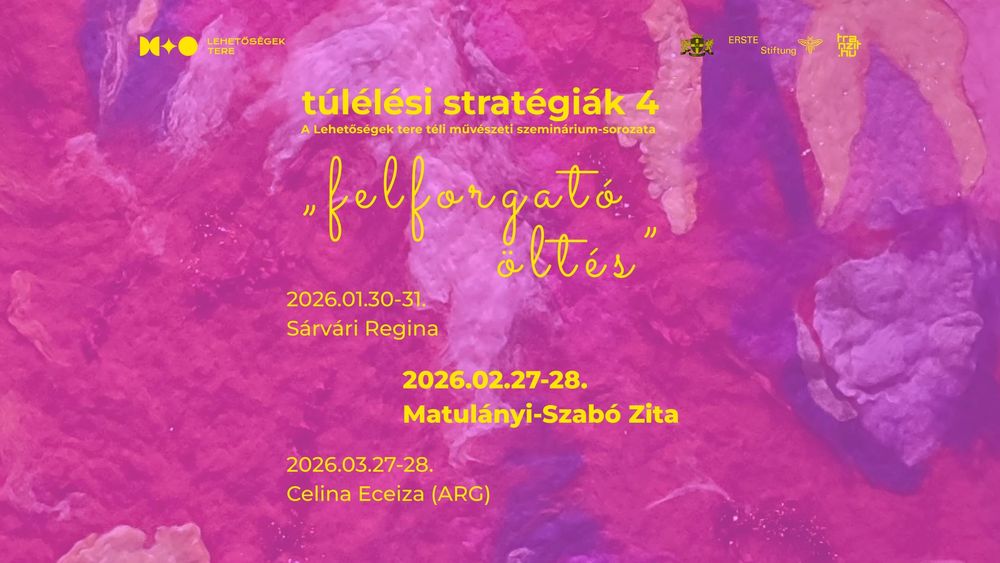
Schedule
Survival Strategies IV.
“𝓢𝓾𝓫𝓿𝓮𝓻𝓼𝓲𝓿𝓮 𝓢𝓽𝓲𝓽𝓬𝓱” (1)
The fourth part of our Survival Strategies, the winter art workshop series of the Space of Opportunity, will be centred around the concept of the ‘social fabric.’
For a long time, making textiles and needlework were considered occupations or a form of folk art practised exclusively by women. The 1960s and 1970s saw an increasing number of female artists question this attitude and adopt textiles or various forms of needlework as the chief medium of their messages. While forgotten female oeuvres are being rediscovered and using textiles has become a vital trend in art, the form has not been widely acknowledged or admitted to the artistic canon.
When it comes to the collective traditions of working with textiles, the spinning rooms in the villages were the most important places for non-urban social life in wintertime up to the advent of modernization in the 20th century. In addition to being opportunities for working in company and for passing on skills (spinning, weaving, embroidery) from one generation to the next, these occasions were also important for the cultivation of connections, the exchange of information and entertainment – including for the men who dropped by. While the modern lifestyle has mostly deprived needlework of its usefulness, women’s activist groups around the world keep rediscovering this tradition – often in archaic women’s communities – and use it as a means of community action against social injustices.
The expression, ‘social fabric’ likens the structure of society to that of a textile composed of threads. The threads that make up this fabric are the institutions that define the confines within which society can or must function, as well as the invisible connections, norms and unwritten rules that hold it together. This year’s programme focuses on the socio-cultural environment that shapes identity, as well as on the need for collective care and protective spaces. The textile- and needlework-based methods introduced by the artists we have invited will allow participants to represent personal and collective stories. The sessions are also meant to facilitate the creation of momentary or permanent communities through the act of collective creation. You do not need any experience in needlework to participate in the workshop; we will create a space where anyone can work with textiles, regardless of their gender/affiliations/interests.
(1) The title refers to a 1984 book by British feminist art historian Rozsika Parker, in which she shows how, historically, needlework has been associated with femininity and the role of the passive housewife, and how, from the 19th century onwards, it became a means of resistance and self-expression for women.
Details:
The program consists of the artist’s Friday evening presentation (public and free) and a Saturday workshop (registration required, participation fee applies).
One workshop: 10.000 Ft
For students: 5.000 Ft/workshop
Registration: https://forms.gle/sVsEf4t4tYfFjE8z8
Application deadline for the second session: February 23, 2026 (midnight)
If paying the fee is a challenge for you but you would still like to participate, please contact us at [email protected].
Prater 63 // Space of Opportunity
Space of Opportunity is a cultural-educational programme and a community space for young adults (16-35 years old). It provides an opportunity to engage in critical thinking and in dialogue, as well as an opportunity for encounters, experiential learning and creation.