Almost Nothing - Botond András KISS & Dániel NAGY
The exhibition Almost Nothing explores fundamental and timeless artistic questions through two distinct media: how a surface becomes an image, material becomes form, and gesture becomes presence. The drawings of Botond András Kiss and the sculptures of Dániel Nagy are connected not merely through formal parallels; in their lines of inquiry, they render the boundaries between painterly and sculptural thinking permeable. Within their works, diverse formal languages, material qualities, and visual traditions converge on a shared horizon where the very operation of the medium itself becomes the subject of investigation.
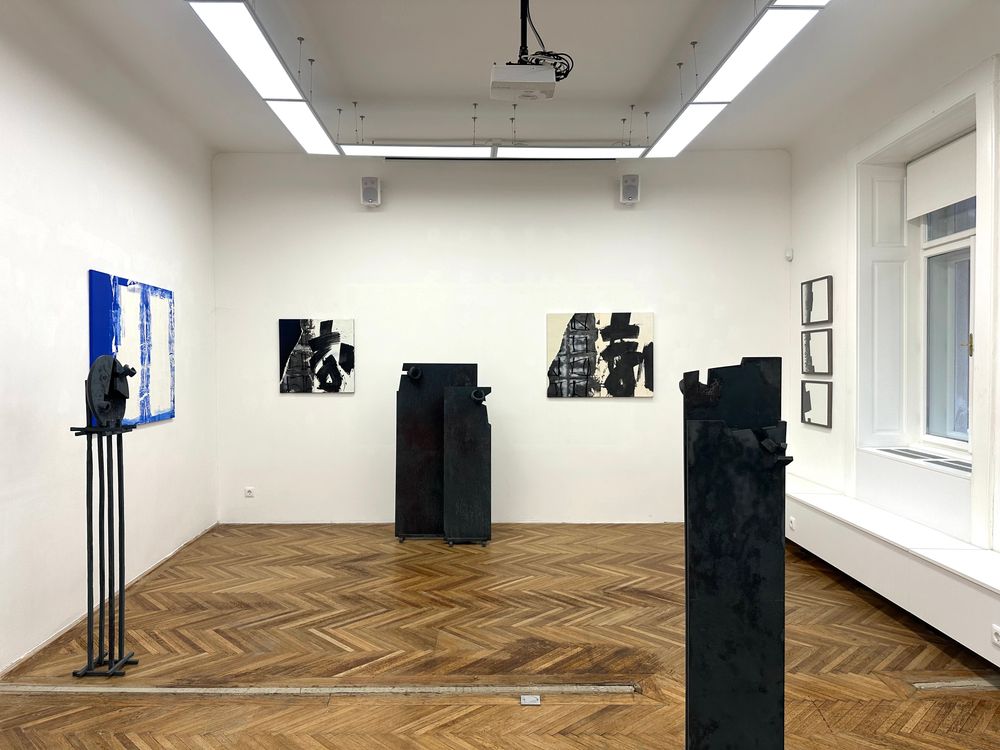
Botond András Kiss’ works focus on the conditions of the image’s emergence - on the threshold at which the smallest mark appearing on an empty surface becomes a pictorial event. His compositions dismantle the traditional hierarchy of foreground and background: dark and light, black and white, saturated form and empty color field mutually shape one another. Intuitive, seemingly incidental gestures and sharply contoured forms are organized into unity without qualitative distinction, so that the relationship between presence and absence is continuously rewritten across the picture plane. In his works, the support - the paper itself - does not function as a passive surface but participates as an active, formative element in the construction of the image. The material quality of the surface thus appears not as a backdrop but as one of the determining conditions of pictorial operation. The specific properties of different types of paper - their texture, tone, and fiber structure - enter into an equal relationship with gestures, fingerprints, geometrizing forms, and homogeneous fields within a pictorial space that evokes a sense of openness and incompletion.
Similar concerns shape Dániel Nagy’s sculptural practice: he is engaged with the minimal displacement within material that already becomes perceptible as artistic formation. His works are not so much fixed objects resolved into stable forms as they are traces of transition between action and material. The organic formal language of his sculptures and the transformations visible on their surfaces can be read as extensions of painterly gesture; they record the memory of bodily presence and intervention within matter. This process is grounded in the way the surface of forged iron is shaped by contact with fire, deliberate formation, the passage of time, and exposure to the environment. Formal and surface transformations thus signify not merely change, but the ongoing interaction between material and its surroundings. Through deformations brought about by heat and touch, the material is not a passive recipient but an active participant in the process of becoming.
The works of these two young artists are linked not only by formal affinity but by a shared ontological inquiry. Botond András Kiss and Dániel Nagy examine the inherent laws of material, the role of gesture, and the transitional states between form and formlessness, permanence and momentariness. Their artistic practices are characterized by a distinctive balance between intensive physical intervention and a reflective, philosophical attitude. The title of their joint exhibition points to the intersection of their artistic worlds, where emptiness is understood as the condition for the emergence of form. This mode of thinking resonates with Eastern philosophical traditions that interpret emptiness not as absence, but as an open state of potentiality. “Almost nothing” thus designates that elusive domain in which emptiness and presence, nothingness and somethingness, are understood not as opposites but as mutually generative qualities existing in continuous transition - where the traces of these shifts become perceptible in the transformation of material, gesture, and form.
The Space Art Gallery
The Space, which opened in July 2022, is more than just an exhibition venue — it functions simultaneously as a community hub, educational space, and art management centre. Our goal is to create a meeting point between those interested in contemporary art and key figures in the art world — artists, collectors, and curators. We believe that art can also be a communal experience, so alongside exhibitions, we welcome our visitors with lectures, guided tours, discussions, workshops, and other inspiring events.
Our home is located in a unique Art Nouveau building in the heart of Budapest’s 1st district, on Hattyú Street. Built in 1913, the house originally evoked the atmosphere of the turn of the century with its richly decorated towers and elegant details — and although it has undergone many changes over time, it has preserved its character. When stepping through the gate, one might feel as if they have entered a Parisian inner courtyard — the building’s distinctive charm provides the perfect setting for presenting contemporary art.