Drawing on Books X. // Janka Kovats: Wrong side

The Drawing On Books series is the visual experimental field
of the Museum of Ethnography’s MaDok-program, which focuses
on contemporary phenomena. Within the series, contemporary
artists create temporary wall drawings on the
black chalk wall next to the museum bookstore, drawing inspiration
from the museum’s publications.
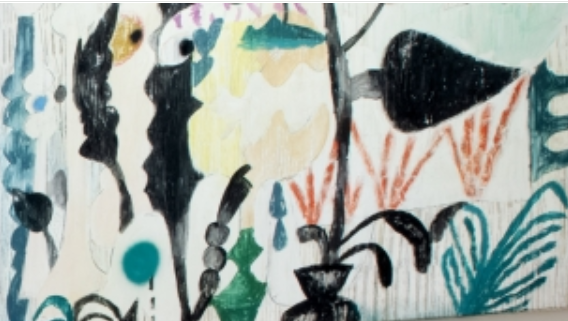
The wall drawing takes as its starting point the Jelenarchívum
story Lunch Break at Work (1992, Inke), in which workers
spent their lunch breaks doing handicrafts for pleasure:
knitting, embroidering and sewing, and teaching one another
as they did so.
In this context, Janka Kováts drew inspiration from traditional
handicrafts, and in particular from the reverse side of
cross-stitch embroidery. On the front, the embroidery presents
an orderly, carefully planned pattern, while the reverse
bears the traces of the making process: the paths of the
threads, their crossings, knots, fastened-off ends and irregularities.
For Janka, this other side – the looser, more distorted,
almost random network of lines emerging on the reverse of
the fabric – became a visual world in its own right.
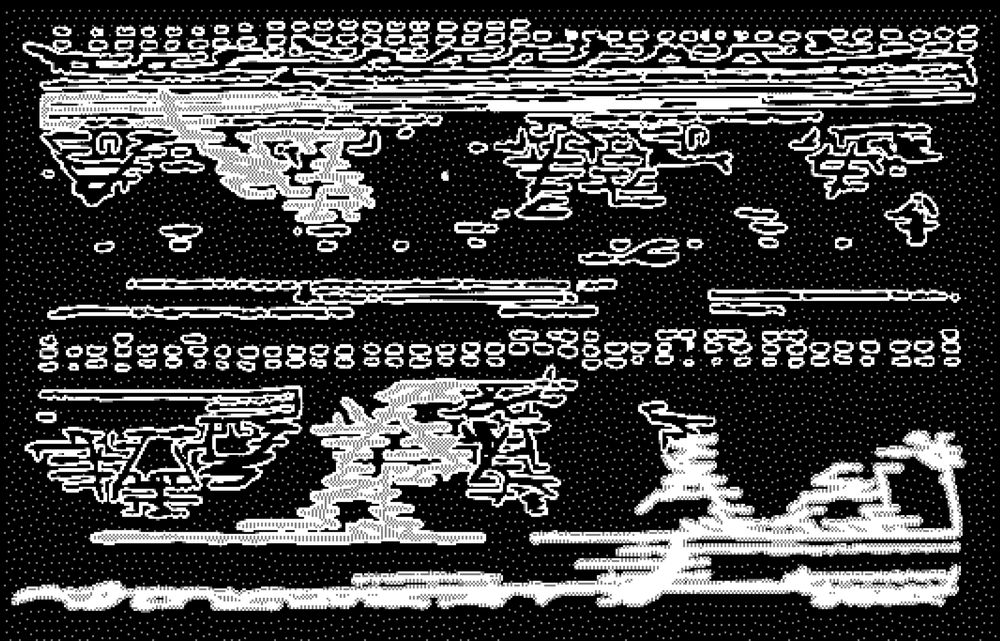
The artist does not reproduce a specific piece of embroidery;
instead, she builds a new pattern from the network of lines,
distortions and repetitions on its reverse, creating a looser,
more irregular web. Rather than the finished piece itself, she
reveals its hidden side, the process behind it and the traces
of its making.
Schedule
- 15:00-16:30https://fb.me/e/4MmBgTnpr
In the past, handicraft was part of the rhythm of everyday
life. Today, it is increasingly popular, though its function
has changed somewhat. In peasant culture, such work was
above all an essential everyday skill; today, by contrast, it
often serves as a deliberate counterpoint to a fast-paced,
mechanised way of life built around mass production and
consumption. Yet the essence remains the same in both
cases: a person does not merely use an object, but gives it
meaning through their own labour.
The wall drawing takes as its starting point the Jelenarchívum
story Lunch Break at Work (1992, Inke), in which workers
spent their lunch breaks doing handicrafts for pleasure:
knitting, embroidering and sewing, and teaching one another
as they did so.
In this context, Janka Kováts drew inspiration from traditional
handicrafts, and in particular from the reverse side of
cross-stitch embroidery. On the front, the embroidery presents
an orderly, carefully planned pattern, while the reverse
bears the traces of the making process: the paths of the
threads, their crossings, knots, fastened-off ends and irregularities.
For Janka, this other side – the looser, more distorted,
almost random network of lines emerging on the reverse of
the fabric – became a visual world in its own right.
The initial idea took shape when she came across an old
graduation pouch decorated with cross-stitch embroidery.
Later, looking at cross-stitch pieces made by her and her
mother, she became increasingly aware of all the work, adjustments
and small decisions that go into them, none
of which is visible in the finished piece. The wall drawing
brings this hidden side into view.
The artist does not reproduce a specific piece of embroidery;
instead, she builds a new pattern from the network of lines,
distortions and repetitions on its reverse, creating a looser,
more irregular web. Rather than the finished piece itself, she
reveals its hidden side, the process behind it and the traces
of its making.
Janka Kováts (1999) is a visual artist working across sculpture,
textiles and printmaking. In her work, she explores the
relationship between material, form and structural systems,
developing objects and installations through rule-based processes
and spatial thinking. By combining analogue and digital
design methods, she investigates how controlled structures
and the inherent behaviour of materials work together
to generate form.
The Drawing On Books series is the visual experimental field
of the Museum of Ethnography’s MaDok-program, which focuses
on contemporary phenomena. Within the series, contemporary
artists create temporary wall drawings on the
black chalk wall next to the museum bookstore, drawing inspiration
from the museum’s publications.