Created Order – The Universe of Lajos Dargay

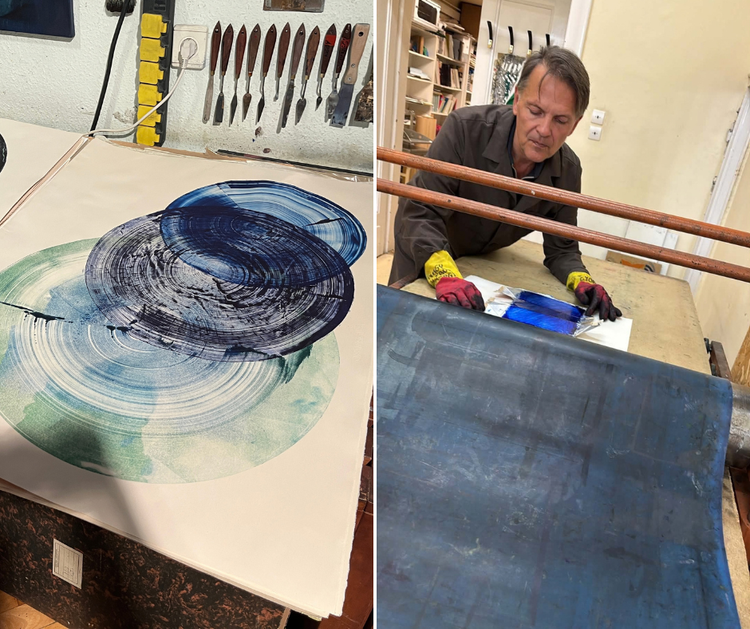
As a student of Nicolas Schöffer and a continuator of his artistic legacy, sculptor Lajos Dargay was one of the pioneers of kinetic and cybernetic art in Hungary. His retrospective exhibition will primarily feature mobiles, sculptures, reliefs, and prints that explore the relationship between movement, light, and space. His works embody the harmony of geometry and dynamics.
Lajos Dargay’s oeuvre represents one of the most unique chapters in Hungarian sculpture, where ancient ideals meet modern natural science and engineering precision. The central concept of his art is Kalokagathia: the unity of beauty and spiritual perfection, which takes shape in his abstract, clean-lined reliefs and sculptures. For him, sculpture was not the art of mass but of space, where the work can be interpreted as a projection of the order of the surrounding universe.
At the beginning of his career, he was inspired by masters such as Tibor Vilt and Erzsébet Schaár, but his early forms were soon replaced by the influence of the international avant-garde. During his study trips, the ideas of László Moholy-Nagy and Nicolas Schöffer became his guiding principles. In the 1970s, he turned toward luminokinetic art: his open reliefs and moving sculptures incorporated virtual space and time into the artwork through reflected light and shadows. His works are characterized by profound scientific rigor; the golden ratio and geometric representations of astrological constellations serve as harbingers of a transcendent worldview.
Schedule
Through his works, Dargay reveals to us the order of nature, the microcosm, and the macrocosm, which he believes can be made visible through geometric structures. These works, which allude to the constructive presence of a person seeking the harmony of the cosmos, teach the viewer to embrace this order. They are built on the classical belief that there is a pure and perfect system within the visual “structure” of the universe, one that can be recognized and realized on both an individual and communal level. He envisioned his constructions in a modern urban environment, where the sculpture functions as a “cultic landmark.”
Although his monumental designs—with the exception of the Eger light tower—remained mostly dreams, he realized his vision in his small-scale sculptures with a demand for completeness. The ideal of “the beautiful and the good” takes on new form through Dargay’s lines, lights, and reflections, affirming the timeless message of Kalokagathia and the better self of human nature.
Curator: Zoltán Rockenbauer
Kunsthalle Budapest
The largest exhibition hall in Budapest, in Heroes Square, just the opposite the Museum of Fine Arts.