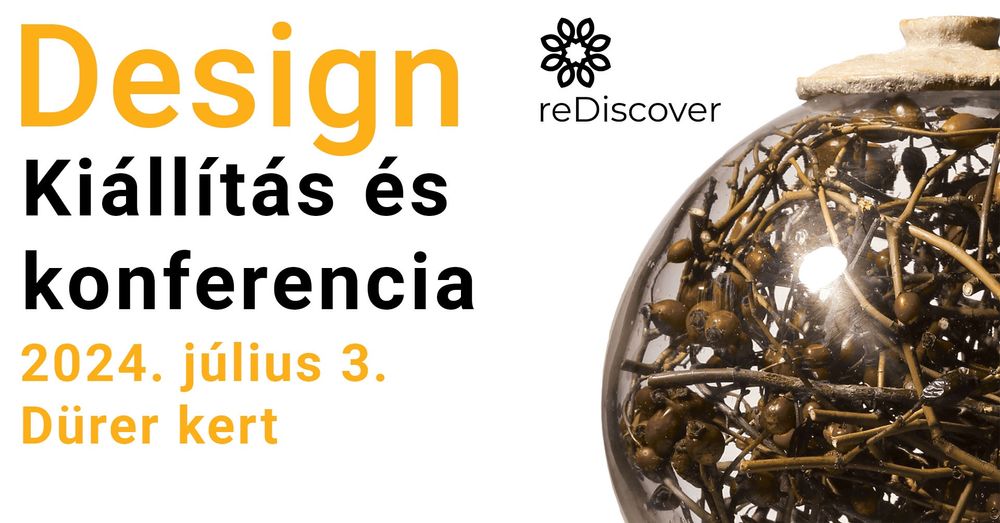
reDiscover exhibition and conference
Conference and exhibition on the relationship between traditional knowledge and contemporary design
Schedule
Programme:
13:00-16:00. Conference speakers
Language: English, Hungarian interpretation provided.
All programmes are free of charge.
Zoltán Lublóy DLA (Hungary), Moholy-Nagy University of Art and Design
Heritage and Modernity
Links between contemporary design and traditional craftsmanship. How can our folk art and traditional techniques survive in the near future?
Tanja Devetak, Assoc. Prof (Slovenia), Design Research Centre
Comparison of craft and design education practices in Slovenia and Europe
This presentation will provide insights into the diversity of craft and design education practices in Europe, with a special focus on Slovenia, with the aim of promoting a deeper understanding of the factors influencing teaching and learning in this field in different cultural and institutional contexts.
Assoc. Prof. Ayşe E. COŞKUN, PhD (Turkey), Kadir Has University, Department of Industrial Design
The new old: a view of the past and tradition in design
Old, traditional ways of creating can seem boring and old-fashioned to contemporary everyday life. Yet we can learn a lot from the past and draw a lot of inspiration from it. The lecture will explore new ways of contemporary design and introduce a new visual language to the world of design. Examples of traditional manufacturing techniques, craft skills or any part of a production process that reflects a unique and authentic visual language, be it a shape, a pattern, a decorative element or even a texture, will be presented.
Tea Gotsiridze (Georgia), Art Historian, Georgian Centre for Arts and Culture
Traditional techniques in Georgian contemporary design
A brief overview of Georgian historical craft techniques - Cloisonné enamel, felt and ceramics - and their transformation into Georgian modern artworks.
Ivona Haush (Poland), Experimental Design Studio, Gdańsk Academy of Fine Arts
RE-innovations: respect for tradition in the light of modern design technologies
How can we reinterpret the heritage of our ancestors and integrate it into modern design? Examples of projects at the Academy of Fine Arts in Gdańsk.
16:00-18:00. Craft demonstrations and master classes
Réka Farkas: Leather techniques
During the workshop, participants will gain hands-on experience of different leather craft techniques, including dyeing, wax batik, leather weaving and simple leather button making. Participants will also learn about different uses of leather and have the opportunity to take home samples and make unique leather jewellery.
Mirtill Seregély.
Participants will learn about the process of shaping and baking folk art gingerbread figures using hand-carved moulds with traditional designs such as hussar, sword, horse, doll, heart. Participants will also learn about the rich history and symbolic messages of Hungarian gingerbread designs. Participants can take home the gingerbread they have made.
Csíki Virág: Felting demonstration
Felt is an extremely versatile material that can be used to make clothing, home textiles, footwear, toys and even felt tents. Now, to give you a taste of the technique, we're going to dream up jewellery from two simple elements: balls and string. There will be a few easy ideas, but the sky's the limit. The complexity and elaboration of the finished object will depend on the ideas and energy invested by the participants.
18:00. Exhibition opening and award ceremony
Opening of the reDiscover travelling exhibition in Budapest and award ceremony for the winners. The exhibition will provide an opportunity to explore the impact of traditional knowledge on contemporary craftsmanship today. Design works that creatively reflect or re-think the traditional craft traditions of five countries - Georgia, Hungary, Poland, Slovenia and Turkey - will be exhibited. As part of the exhibition, we will also showcase the work of ceramics students from the School of Education.
19:00. Berka: concert and dance
The Berka ensemble, founded in 2008, interprets the music of the Moldavian Csángó people in a variety of ways. Their commitment to the region is also demonstrated by their bi-weekly dance-hall series, which has been running for more than a decade and has resulted in hundreds of dance-halls for adults and children. The orchestra also performs with great success throughout Europe. In addition to Moldavian music, they also play music from Gyimes, Felcsik and Somogy, and they enjoy playing medieval music.
Dürer Kert
Dürer Kert, which moved from the City Park to the vicinity of Kopaszi Dam, is one of the hangouts of Budapest's surviving peripheral subcultures, but it's also worth visiting if you just want a perfect garden spot. That is, starting in spring. Until then, let's keep rockin'! And after that, too.