What Will Remain - Györgyi CSÉFFAI & Liz MILLER KOVACS

The works of Liz Miller Kovács and Györgyi Cséffai enter into dialogue in the exhibition What Will Remain guided by the themes of nature and the body, injury and memory. The depiction of intersections between landscape and body, nature and female experience, is a central concern for both artists. Their works reflect on contemporary experiences of ecological crisis, industrial exploitation, and physical and mental vulnerability. Although they work in different media, they share a similar perspective: both explore the archaeology of nature and memory, reading stories from wounds and simultaneously constructing individual and collective visions of the future shaped by care and fragility.
Schedule
The works of Liz Miller Kovács and Györgyi Cséffai enter into a dialogue along the concepts of nature and body, injury and memory in the exhibition What Will Remain. The depiction of the intersections between landscape and body, nature and female experience is a central concern for both artists, whose works engage with contemporary experiences of ecological crisis, industrial exploitation, and bodily and mental vulnerability. Although working in different media, the two artists share a similar approach: both investigate the archaeology of nature and memory, reading stories from wounds, and simultaneously constructing individual and collective visions of the future shaped by care and fragility.
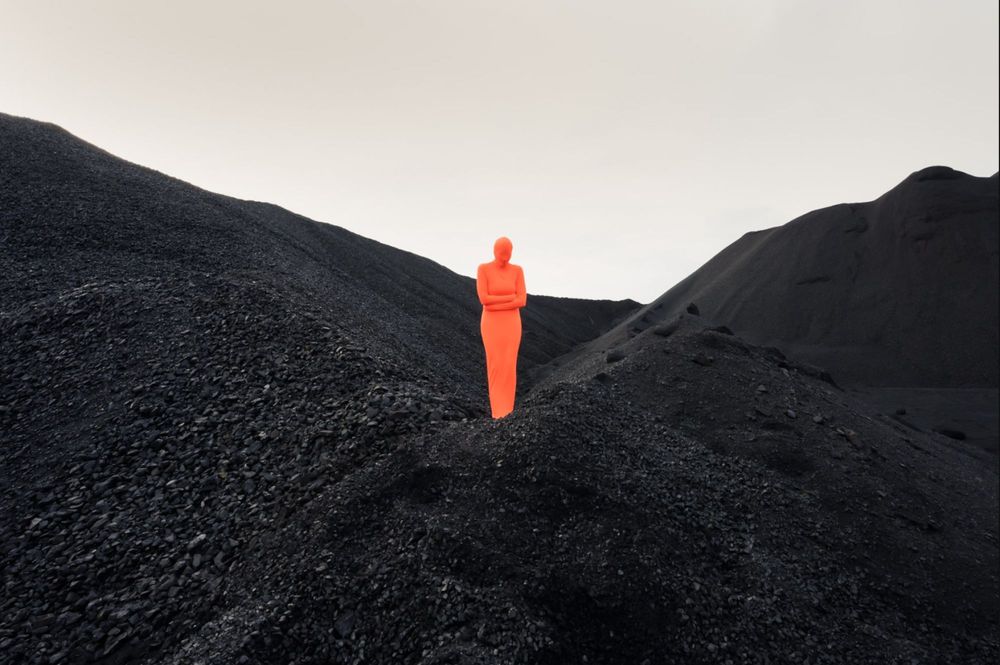
Born in Los Angeles and currently living in Berlin, Liz Miller Kovács is a photographer and interdisciplinary artist. Her practice explores the parallels between Anthropocene landscapes and the female body. In her large-format photographs, she documents industrial landscapes—mining regions, waste disposal sites, quarries—places where human intervention has left visible and lasting traces on the natural environment. Yet, the landscape is not merely the subject of documentation but also an aesthetic construct that gains new significance within an art-historical context. Her compositions reference Romantic landscapes and the aesthetics of the sublime, particularly the paintings of Caspar David Friedrich, which she interprets from a contemporary, critical perspective. The colourful, anonymous, and faceless female figures that appear in her images evoke not only Friedrich’s solitary wanderers but also the historical and aesthetic objectification of the female body: through poses and postures familiar from classical female representations, the passive, exposed body subjected to the viewer’s gaze becomes a central concern. Despite their sculptural quality, the figures in the photographs are not passive; they testify, resist, and rise like totems from the industrial landscape. The photographs can also be seen as performative documents, as the artist creates these self-portraits embedded in real landscapes. They can be interpreted as a visual legacy of a civilisation that leaves behind the destruction of its own conditions of existence. In Miller Kovács’s work, the architecture of the idealised landscape is constructed through the aestheticisation of environmental destruction; her works simultaneously depict natural beauty and carry the unsettling presence of decay.
Young visual artist Györgyi Cséffai approaches the connections between nature and femininity from an intimate, personal viewpoint through her ceramic and organic material-based objects and installations. Her works explore experiences of vulnerability, fertility, mortality, motherhood, and loss. In her central installation, cracked spherical forms embedded in the earth symbolise female archetypes, representing not only bodily changes but also traces of time and life cycles. The interactive installation of ceramic seeds arranged in concentric circles focuses on the experience of becoming a parent, referencing the nine months of pregnancy and consisting of 252 unique elements. The work investigates the preservation and sowing of thoughts and memories as seeds—material, active forms of sharing and care. Cséffai has hidden messages within each seed and invites visitors to take pieces of the installation with them; however, the personal memories related to pregnancy contained inside become accessible only if the ceramic shell is broken. Through this, the work becomes not only a metaphor for birth but also a medium for knowledge, memory, and responsibility. The choice to keep the seed closed or to break it open—like the cracking of the body’s shell—carries experiences of both vulnerability and liberation. Cséffai’s works feature motifs from folk culture and archaic craft techniques, presented in contemporary, often ephemeral forms. Her work approaches the relationship between the female body and nature not as an idealised concept but as a material presence, interpreting the traditional organic visual language as a unique space of memory and sensuality.
The works of Liz Miller Kovács and Györgyi Cséffai reflect from different viewpoints on the parallels between ecological and bodily changes, and the historical and contemporary representations of nature and the female body. The exhibition builds on collective memory and experience, while simultaneously posing questions about the future of nature and humanity. What will remain after us? What kind of legacy will all that we leave behind become? The works of Liz Miller Kovács and Györgyi Cséffai examine the possibilities of transformation and regeneration, preservation and care along the fluid boundaries between body and nature.
Written by Zsófia Máté
Events:
Opening: Wednesday, 16 July 2025, 18:00–20:00
Artist Talk with Györgyi Cséffai: 23 July 2025, 6pm
In conversation with gallerist Linda Bérczi about vulnerability, motherhood, and the rituals of remembrance.
Artist Talk with Liz Miller Kovács: 27 August 2025, 6pm
Photographer and interdisciplinary artist Liz Miller Kovács discusses her artistic practice and the aesthetic, environmental, and historical representations of the female body in a personal Artist Talk moderated by Linda Bérczi (in English).
The exhibition is open from 17 July to 29 August 2025, according to summer opening hours: Tuesday to Thursday, 12:00–18:00, or by appointment.
The gallery will be closed for summer break from 9 to 26 August.
By attending the events, visitors consent to being photographed or filmed during the event.