Survival Strategies IV. – „Subversive Stitch”

The fourth part of our Survival Strategies, the winter art workshop series of the Space of Opportunity, will be centred around the concept of the ‘social fabric.’
Schedule
For a long time, making textiles and needlework were considered occupations or a form of folk art practised exclusively by women. The 1960s and 1970s saw an increasing number of female artists question this attitude and adopt textiles or various forms of needlework as the chief medium of their messages. While forgotten female oeuvres are being rediscovered and using textiles has become a vital trend in art, the form has not been widely acknowledged or admitted to the artistic canon.
When it comes to the collective traditions of working with textiles, the spinning rooms in the villages were the most important places for non-urban social life in wintertime up to the advent of modernization in the 20th century. In addition to being opportunities for working in company and for passing on skills (spinning, weaving, embroidery) from one generation to the next, these occasions were also important for the cultivation of connections, the exchange of information and entertainment – including for the men who dropped by. While the modern lifestyle has mostly deprived needlework of its usefulness, women’s activist groups around the world keep rediscovering this tradition – often in archaic women’s communities – and use it as a means of community action against social injustices.
The expression, ‘social fabric’ likens the structure of society to that of a textile composed of threads. The threads that make up this fabric are the institutions that define the confines within which society can or must function, as well as the invisible connections, norms and unwritten rules that hold it together. This year’s programme focuses on the socio-cultural environment that shapes identity, as well as on the need for collective care and protective spaces. The textile- and needlework-based methods introduced by the artists we have invited will allow participants to represent personal and collective stories. The sessions are also meant to facilitate the creation of momentary or permanent communities through the act of collective creation. You do not need any experience in needlework to participate in the workshop; we will create a space where anyone can work with textiles, regardless of their gender/affiliations/interests.
(1) The title refers to a 1984 book by British feminist art historian Rozsika Parker, in which she shows how, historically, needlework has been associated with femininity and the role of the passive housewife, and how, from the 19th century onwards, it became a means of resistance and self-expression for women.
________
The program consists of the artist’s Friday evening presentation (public and free) and a Saturday workshop (registration required, participation fee applies).
Three workshops: 21.000 Ft
One workshop: 10.000 Ft
Registration: https://forms.gle/sVsEf4t4tYfFjE8z8
Application deadline for the first session: January 26, 2026 (midnight)
If paying the fee is a challenge for you but you would still like to participate, please contact us at [email protected].
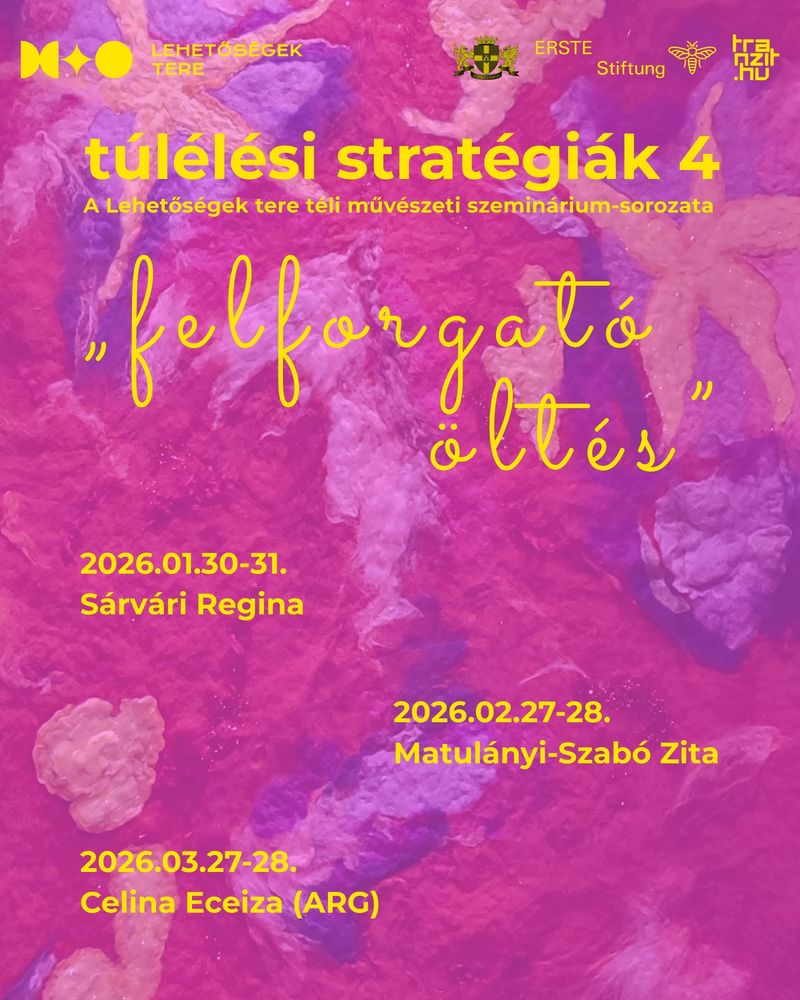
January 30, 2026, 18.00 – 19.30 Presentation by Regina Sárvári
January 31, 2026, 11.00 – 17.00 Workshop with Regina Sárvári
𝓣𝓱𝓮 𝓟𝓸𝓵𝓲𝓽𝓲𝓬𝓪𝓵 𝓲𝓼 𝓽𝓱𝓮 𝓟𝓮𝓻𝓼𝓸𝓷𝓪𝓵
The workshop is based on the idea that „the personal is political,” a slogan that became widespread during the second wave of feminism. It expresses the belief that women’s personal experiences are shaped by their political situation and by gender inequality. Housework, childcare, and care work – often seen as part of private life – are in fact forms of labor and matters of public concern. The fact that this work, usually done by women, is not properly recognized, reveals that society functions unequally and that oppression is built into social systems.
Taking this well-known slogan and applying it to our present situation, we can also turn it around and say: „the political is the personal.” In this sense, the phrase refers to the way a hostile, patriarchal, and sexist political environment affects and crosses borders to our private lives. In the workshop, participants work with political and public statements that we hear in everyday life. These statements negatively shape our personal lives, emotions, career paths, life goals, gender and social identities, and the rights connected to them. They include widely quoted slogans by politicians and provocative messages of political propaganda, such as „No migration. No gender. No war.” or „Hungary is moving forward! Not backward.” Using irony and humor, we give new meanings to these texts, which often spread fear and reinforce oppression. In a safe and supportive community, we will sew these phrases onto our own personal and intimate items: our underwear. By placing these political messages onto our underwear, we appropriate and take control of the statements that invade our private sphere. Through this process, we reinterpret, disarm, and empty these phrases of their power, symbolically turning them to our own benefit and releasing the frustration they cause.
What to bring?
Please bring at least one item of underwear on which you will sew a chosen text during the workshop.
Who can take part?
The workshop is open to everyone, regardless of gender or gender identity.
𝓡𝓮𝓰𝓲𝓷𝓪 𝓢𝓪´𝓻𝓿𝓪´𝓻𝓲 is a visual artist and cultural worker. She graduated in 2024 from the Intermedia Department of the Hungarian University of Fine Arts. Since then, she has been a member and a board member of the Studio of Young Artists’ Association (FKSE). In her artistic practice, she explores various social, political, historical, and ecological issues through artistic research. She works across different media and techniques, including photography, video, performance, and textiles. Collaboration is central to her practice, as well as collective thinking and creation, and horizontal knowledge sharing.
February 27, 2026, 18.00 – 19.30 Presentation by Zita Matulányi-Szabó
February 28, 2026, 11.00 – 17.00 Workshop with Zita Matulányi-Szabó
𝓩𝓲𝓽𝓪 𝓜𝓪𝓽𝓾𝓵𝓪´𝓷𝔂𝓲-𝓢𝔃𝓪𝓫𝓸´ intermedia artist lives and works in Budapest. Her works combine the symbolism of religious stories and folk tales with personal narratives. Her artistic practice is based on the processing of family and relationship dynamics, as well as physical symptoms, illnesses, and stories of healing. She works with video performances, used textiles, wool, and various felting techniques, switching between media with self-evident ease. She places traditional textile techniques in a contemporary context, while consciously deconstructing and rearranging their layers of meaning.
„𝓘𝓷 𝓢𝓱𝓮𝓮𝓹’𝓼 𝓒𝓵𝓸𝓽𝓱𝓲𝓷𝓰…”
During the workshop, we will create felt appliqués through a self-reflective process, drawing inspiration from personal symbols and narratives. We will work with a combination of wet and needle felting techniques.
https://szabozitaszabo.myportfolio.com/
More details about the workshop will follow.
March 27, 2026, 18.00 – 19.30 Presentation by Celina Eceiza
March 28, 2026, 11.00 – 17.00 Workshop with Celina Eceiza
𝓒𝓮𝓵𝓲𝓷𝓪 𝓔𝓬𝓮𝓲𝔃𝓪 is an artist and writer, who lives and works in Buenos Aires. In her installations, created mainly from hand-made textiles, space is conceived as a metabolic organ, capable of absorbing and processing different physical and psychological states, as well as various practices, beliefs, desires, and rituals. In the words of curator Jimena Ferreiro: „Celina Eceiza’s installations invite you to partake in pleasant, porous and expansive environments. Constructed as if they were states of mind, these spaces yearn to be experienced by a body that forgets its rational nature and gives way to the pure will of sensitive knowledge. This intimate and, at the same time, collective experience displays its political power by presenting art as a living form that must be nurtured in order to reveal new possible links between humans.”
Details about the workshop will follow.
Prater 63 // Space of Opportunity
Space of Opportunity is a cultural-educational programme and a community space for young adults (16-35 years old). It provides an opportunity to engage in critical thinking and in dialogue, as well as an opportunity for encounters, experiential learning and creation.