Ferenc Lantos What can enamel do? A selection of enamel works by Ferenc Lantos

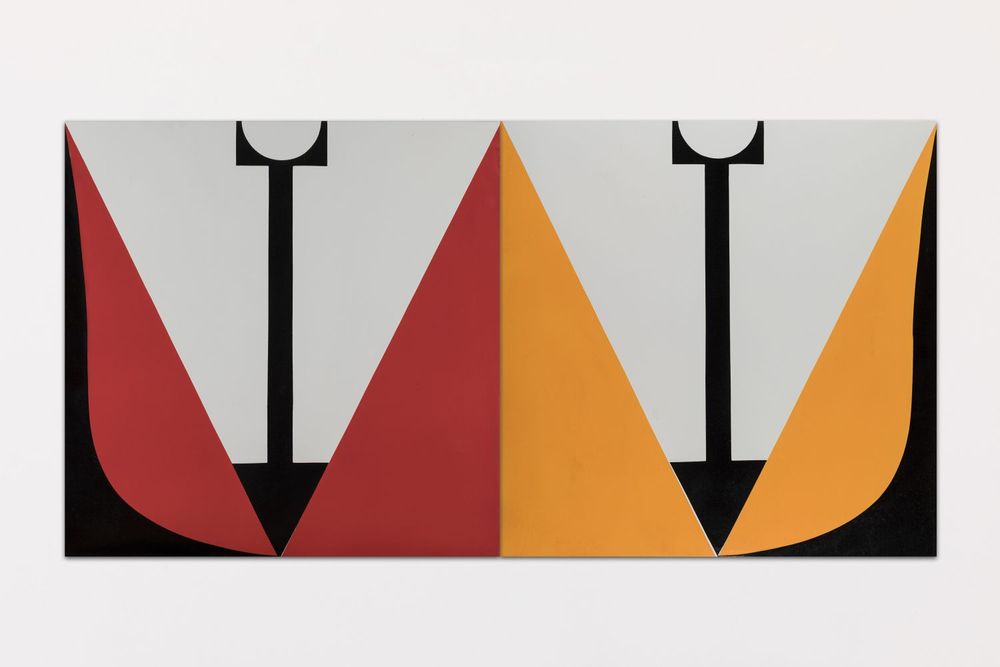
One of the first pioneers of the symposium movement, which flourished in Hungary at the end of the sixties, was the Bonyhád Enamel Artists' Association. The participating artists, led by Ferenc Lantos, were liberated by the experimentation with enamel, a new material. The exhibition at acb Plus shows how Lantos transferred his consistent visual system, already known from his prints, to enamel technique, while creating a whole new type of work, imagined on buildings, public spaces and in the natural environment. Lantos developed his own visual language of enamel panels, using the technical possibilities of enamel, the familiarity of the factory workers, and the long-lasting, rich opaque colours and repetitive forms of the stencils he fired. The main work of Lantos's architectural oeuvre is the DÉDÁSZ frieze, some panels of which are included in his exhibition at acb Plus.
Schedule
In the 1960s, Ferenc Lantos (1929-2014) developed a consistent visual language of form through organic experiments that broke down the natural landscape into geometric elements in a Mondrian sense. His master was the former Abstraction-Création member Ferenc Martyn, under whose influence Lantos sought to carry on and renew the abstract and constructivist twentieth-century tradition. By the end of the 1960s, the geometric direction presented in the exhibition had become the dominant one in his art.
acb Gallery
Founded in Budapest in 2003, acb Gallery has consistently grown in the past two decades establishing itself as one of the leading actors in the Hungarian and Eastern European art market. Initially, the gallery’s focus was on Hungarian and international emerging and mid-generation neo-conceptual artists, who became active after the political changes in the former Eastern Bloc in 1990. Since then, the gallery has expanded its focus, and now represents numerous Hungarian neo-avant-garde artists who have left their mark on art history since the 1960s and 1970s, as well as members of the youngest generations beside the already established ones.
Since the autumn of 2022, acb runs three exhibition spaces: the main gallery space, acb Attachment, which serves as a project space, and acb Plus, dedicated to large-scale solo and group presentations.
acb’s research and publishing department, acb ResearchLab was founded in 2015. This platform within the gallery aims to fill the gaps in the reception and publication of Hungarian neo-avant-garde and post-avant-garde oeuvres by studying bodies of works and art phenomena previously treated as peripheral.
The gallery holds significant importance within the global art market, actively promoting its artists nationally as well as internationally and engaging in art fairs, such as the Art Basel in Basel and Art Basel Miami Beach, the Frieze Masters London or the ARCO Madrid.