Kata Könyv | Image-Bodies | Fresh 2026

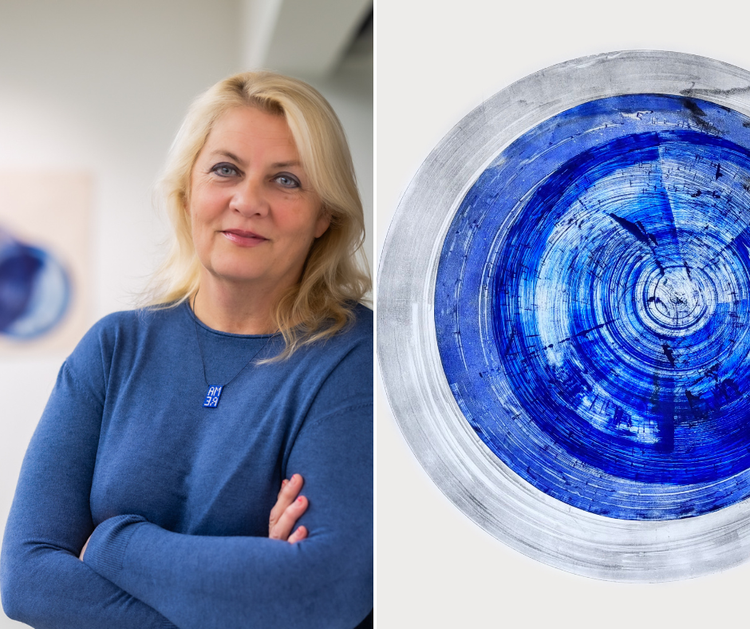
The visual world of Kata Könyv’s expressive painting is characterised by a duality of philosophical thinking and a perspective that transcends reality and tends towards the grotesque. Her figurative art draws on the tradition of classical panel painting, which she reinvents in a contemporary manner; through the use of a wide variety of, often transparent, media and materials, and by interpreting painting as a self-reflexive metalanguage. Through her works, she redefines the oeuvres of artistic predecessors who are important to her, sometimes as works of homage (Michelangelo, Bernini, Caspar David Friedrich, and contemporary female artists), or simply by evoking their visual worlds (Rubens, Piranesi). Her works focus on different aspects of vision and perception; in her paintings she frequently employs the phenomena of reflection and distortion, whilst opening up exciting perspectives through the use of various material devices linked to visuality. Glass-like and metallic surfaces serve as formal representations of purity and fragility, whilst their geometric structure stabilises the dynamics of the pictorial spaces.
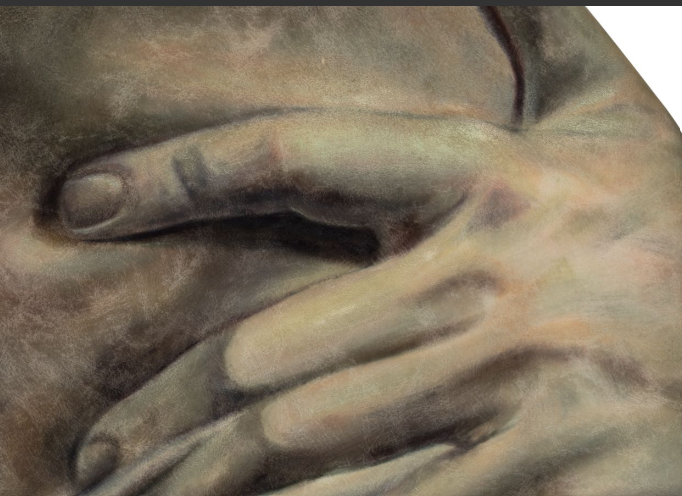
The depiction of the human body plays a prominent role in her art; it consciously contrasts with our era’s idealised concept of beauty, which strives for perfection, in order to make room for the body’s constantly changing, fragile and transient nature. Rather than presenting an absolute, sculptural, monumental depiction of the body, she reveals fragments, expressing wholeness through the principle of pars pro toto, often emphasising the hands and the face, which carry rich symbolism. The face is the expression of personality, the bearer of identity, which also reflects our inner struggles and a transcendent state of being. The sensual lips are passionate, yet of vital importance; the eyes, depicted as mirrors of the soul, simultaneously see and capture the viewer’s gaze. Her self-portraits are visual diaries which, functioning as the most personal of confessions, are also psychological self-analyses. The distorted impressions of facial and hair details—whether viewed through various surfaces—such as glass panes or the metallic surfaces of everyday household objects, or as they appear in ‘scenography’ created using a scanner—evoke a sense of fragmentation, self-reflection and critical contemplation, confronting the viewer with existential questions whilst alluding to the constant flux of identity. This is a documentation of the passage of time, whilst the artist is preoccupied with experiencing the subjective sensations that occur during the creative process. The frequently appearing hands are symbols of creation, action, and erotic or loving embraces; through movements condensed into a single image, they depict various states of being and life situations, simultaneously expressing the fullness of life, its finitude, and the immortality of the soul.
The creation of soft paintings can be regarded as a significant innovation in Kata’s career. Alongside her earlier, classical oil-on-canvas works, she creates tactile, relief-like pieces; these draw inspiration from the formal and visual worlds of ancient, Renaissance and Baroque sculpture, so that the extended dimensions of these soft paintings – homages inspired by Michelangelo and Bernini – can be interpreted as distinctive paraphrases. She transforms the sculptural forms into two dimensions, yet retains their sense of space. A base made of furniture board and foam is covered with micro-plush, onto which she then paints with oil. Her surfaces protrude from the plane, creating trompe-l’oeil effects, thus giving the works a dual perspective; through her use of colours, tones and shadows, the artist is able to convey a sense of complete spatiality. The extended dimensions of these soft images allow us to physically touch them, to feel their texture and depth, as if we were truly close at hand, touching human flesh and skin. These sensations are linked to the feminine principle, evoking experiences of warmth and cosiness. The role of the images mounted on the wall is particularly significant: they eliminate the viewer’s detached position and break down the distance between the image and the viewer, so that the viewer becomes much more a part of the visual—and indeed haptic—experience, enabling them to gain insight into themselves and the world around them whilst engaging with the work.
The marks left on the body or traces of injuries, the moon-like abdominal paintings rendered in bluish tones and arranged in a triptych-like composition, are distinctive paraphrases of American conceptual artist Barbara Kruger’s iconic 1989 poster: reinterpretations of the slogan ‘Your body is a bottleground’, which are also interpreted at the level of social and legal ideologies; yet for Kata Könyv, the sensual representation of bodily experiences remains paramount. In the diptych-like pair of images entitled *Navel Contemplators*, her use of concave and convex spherical mirrors connects her to a significant tradition in art history (e.g. Van Eyck, Velázquez, Holbein, Manet). Her built-in specula primarily prompt us to confront ourselves; through their optical effects, they are capable of both condensing and expanding space, enabling us to interpret the paintings within a socio-cultural context. By depicting the microcosm and the macrocosm, Kata Könyv creates a sense of wholeness, whilst the mirror is simultaneously a symbol of the soul and, linked to vanity, a symbol of vanitas. The gesture of highlighting the navel embodies the cornerstone of cosmic origin and the source of life; interpreted as the omphalos, it marks the axis mundi, where the earthly world meets the sacred dimension. The gesture of gazing at one’s navel is an expression of excessive self-absorption and egocentric thinking; at the same time, it also represents a possible artistic attitude – the artist’s reflection on themselves and their relationship with art.
Réka Fazakas, curator
Schedule
///////
Building on the ideas of Daniel Arasse, the 2026 Frissen exhibition explores the Renaissance thesis that a work of art inevitably reflects the individuality of its creator. Although the death of painting has been predicted on numerous occasions – both since the advent of photography and from the perspective of critiques of capitalism – the genre has always been revitalised and strengthened through aesthetic and social self-reflection. The Műcsarnok’s seventh ‘one artist – one room – one curator’ exhibition seeks to answer the question of why artists paint today. This collection of personal exhibitions showcases the diversity of the profession through the latest abstract and figurative works by six Hungarian contemporary painters, brought directly from their studios.
Artist–curator pairs: Ákos Bánki and Szilvia Reischl, Réka Kaszás and Mária Kondor-Szilágyi, Gábor Király and Gréta Garami, Kata Könyv and Réka Fazakas, Tamás Menyhárt and Zoltán Rockenbauer, Katalin Verebics and Anna Blanka Nagy
Kunsthalle Budapest
The largest exhibition hall in Budapest, in Heroes Square, just the opposite the Museum of Fine Arts.