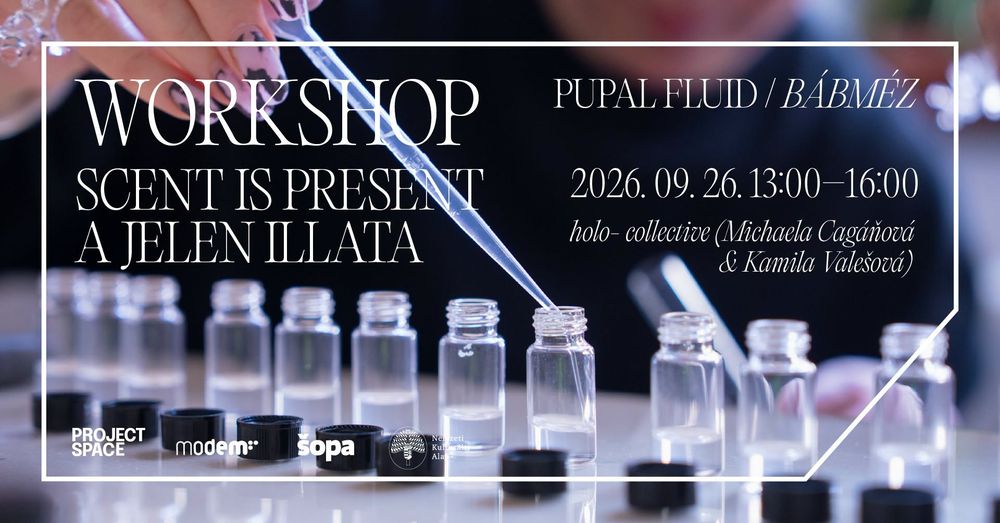
PRE-OPENING WORKSHOP: Scent is Present at holo-: Pupal Fluid exhibition

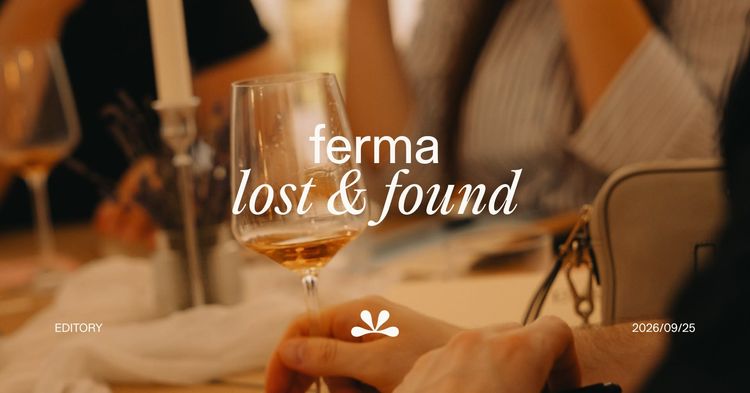
On the day of the exhibition opening, between 1 p.m. and 4 p.m. holo- will lead Scent is Present, a workshop centred on migration.
Participants will experiment with different scent materials before composing, naming and bottling their own scent composition. The migration of cranes provides one point of departure for exploring departure, memory and belonging through scent.
Schedule
Book your place—the spaces are limited!
https://modemart.jegy.hu/.../pre-opening-workshop-scent...
About the exhibition:
MODEM presents Pupal Fluid, a solo exhibition by holo-, the artistic duo formed by transdisciplinary glass artist Michaela Cagáňová and designer Kamila Valešová. The collective’s name stems from the Greek-derived prefix holo-, used in scientific compound words and meaning “whole” or “complete”. Its fragmentary form evokes a sense of interconnectedness.
The title refers to the radical bodily reorganisation that takes place during insect metamorphosis. Inside the pupa, some larval tissues break down, while others persist and are reorganised as the adult body develops. The exhibition takes this transitional state as its point of departure: the previous bodily form is already changing, while the new one has not yet fully emerged.
Formed through a long-standing friendship, the duo’s working method is based on dialogue and interdependence, rejecting the myth of the individual artistic genius. Through field research and collaborations with specialists from different scientific disciplines, they construct hypothetical landscapes and para-fictional narratives that engage with forms of life and communication beyond ordinary human perception. Their work takes the form of installations, glass objects, scent-based projects, publications, performances and workshops. Glass is a recurring material in holo-’s practice: during the making process, its form is shaped by heat and gravity as much as by the artists’ intervention.
At the heart of Pupal Fluid is Autochora, accompanied by scent compositions and glass objects. The installation consists of an altar, five custom-made scent compositions and glass cocoons. Drawing on the visual language of ritual objects, it places microorganisms, insects and plants where anthropomorphic deities might otherwise appear. The altar proposes the possibility of a teaching that requires no human language. The transparent glass cocoons, by contrast, do not reveal what happens within them: we can observe their casing, but the outcome of the transformation remains hidden. In this way, the exhibition approaches metamorphosis as an uncertain transition and draws attention to relationships between human and non-human forms of life.
Smell is the principal narrative device of Pupal Fluid. Five scent compositions trace an imagined cycle of life on the planet: from the emergence of the first organism, through the movement of life onto land, the flourishing of plant life and the arrival of the human, to decay and, finally, extinction. Seawater, algae, sulphur and ozone give way to moss, fungi and roots, then nectar and petals, flesh, bodily fluids, processed leather and coffee, before ending with the smell of a burnt landscape and plastic. Through these speculative “fossils,” holo- continues its research into how scent can become a means of storytelling.
Pupal Fluid does not focus on the outcome of transformation, but holds open the intermediate state in which the previous form is already breaking down while what comes next remains unknown.
---
We reserve the right to alter the program. By attending, visitors consent to the recording of audio and visual media during the event, which may be used by MODEM for promotional purposes.
Center of Modern and Contemporary Art - Modemart
“The MODEM Center for Modern and Contemporary Art is a cultural institution with international connections, which has two main missions: the exhibition of the most significant 20th century Hungarian and international works of art, and the representative presentation of the current schools and progressive efforts of the contemporary visual art and culture as well as most respected Hungarian and international artists.”
The MODEM intends to realise those ambitious goals that the institution has set for itself during the start-up period.
With one of the best infrastructural conditions in East-Central-Europe, the MODEM is to be an essential part not only of the visual art scene but the whole cultural sphere. The art center is suitable to represent that the culture has high priority for the institutes and the whole town. Therefore, one of our basic goals is to make the MODEM a wider intellectual space and forum to where not only the spectators but also the artists return regularly with pleasure.
The primary point of view of the MODEM is the reconstruction of its character in the Hungarian art life, with the cooperation with new elements which strengthen the relation with the local and regional community as well as with the broader international cultural scene in a longer term perspective and form and run a multilevel and manifold network. We aim to create a brand new narrative which change the public opinion about the role of the contemporary art and make the visual art the part of the everyday life. An important goal of our programme is to represent the diversity of the contemporary art and to display the attendant art in different forms. In the selection of thematic exhibitions, not only the visual art gets into focus but the architecture and social science as well.
The Antal‒Lusztig Collection also plays a major role in the MODEM’s life, since it is permanent part of the ground floor exhibition room. The items of the collection are presented by newly arranged exhibitions twice a year. Furthermore, the professional and accurate cataloguing of the collection has started simultaneously as well.