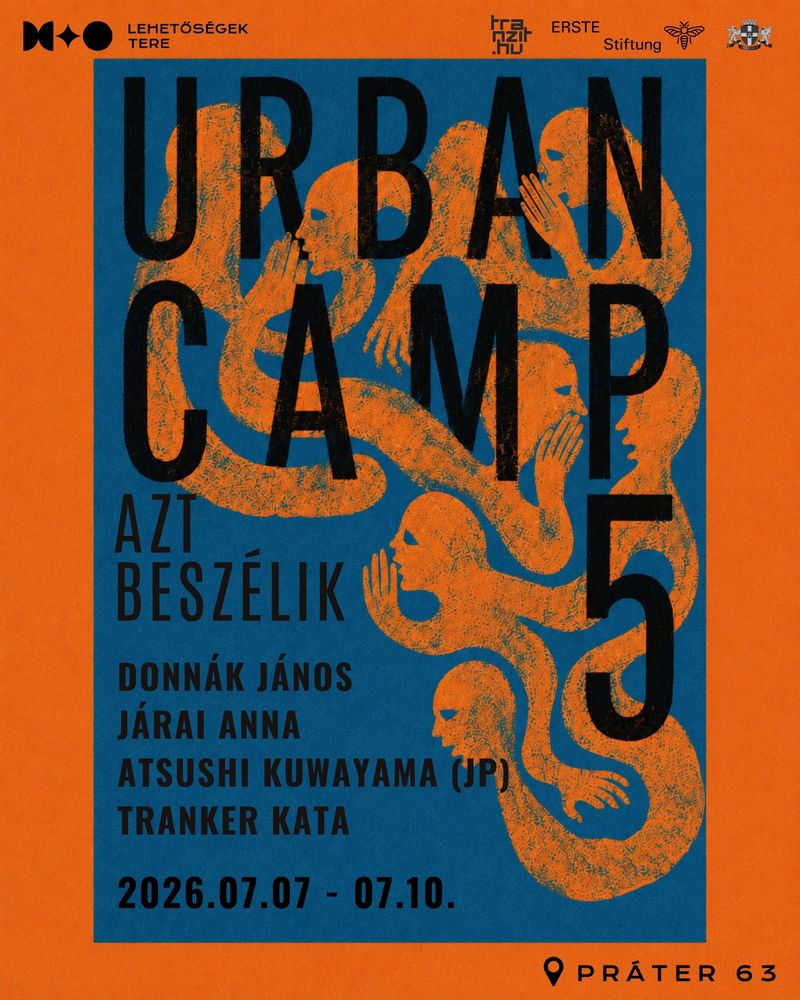
Urban Camp 5 – I Heard a Rumor

Urban Camp, the summer art camp of the Space of Opportunity, is back for its fifth edition. In the last four years, we approached urban spaces from various angles: perceived them through our senses, dug into their historical layers, imagined their possible futures, and explored their non-places — both in a physical and a metaphorical sense. This time, we will venture into the territory where history, myth, and misinformation blur.
Schedule
Urban spaces, cities are full of stories and narratives. Some are documented, some are passed on, some are invented. Official histories coexist with rumors, urban legends circulate as facts, and the digital space gives an unlimited platform for fake news, which affects how people understand the places they live in. Our neighborhood, the wider 'home' of our community space — Józsefváros (the 8th District of Budapest) — is a territory rich in urban legends and myths. Even its name carries a layer of uncertainty. It is widely believed that the district was named after Joseph II. But according to a rumor, the name Józsefváros (Josefstadt) was originally proposed in the 1770s in honor of Saint Joseph, the foster father of Jesus and patron of the church in the Horváth Mihály square. Maria Theresa, assuming the name referred to her son, the future ruler of the Monarchy, happily accepted.
Over the centuries, many stories have shaped the district's image. They are so deeply embedded in its texture that it is almost impossible to distinguish facts from myths. The trope of 'nyócker' — the district's reputation as a kind of sin city — has likewise been fueled by rumors, which have irreversibly shaped its identity.
What interests us is not simply whether something is true or false, but how these stories work: how they spread, how they mutate, transform, and how, at some point, they start to feel real. Myth-making can be both a tool of control and an act of resistance, and the line between the two is rarely clear. With the invited artists, we will engage not only with specific stories but with the nature of storytelling itself — playing with fictions and non-fictions to understand how and why we believe what we believe.
In an era of political and commercial propaganda, disinformation, and fake news, understanding the agency behind non-facts is more than an intellectual exercise — it is a compass for navigating everyday life.
If myths and legends are among the dominant materials of urban space, we want to work with them—not merely analyze them. Following anthropologist Tim Ingold, for whom knowledge emerges through making and direct engagement with materials, the camp treats stories as raw material for narrative construction. Throughout the camp, with the guidance of the artists, we are going to re-invent stories, construct and distort sounds, and stage performative interventions — building an unusual archive, unstable by design, that brings the mechanics of belief into light. If the city is a space of competing stories, then we have to become both its archaeologists and its mythmakers.
We have envisioned the fifth edition of Urban Camp as an expanded project. In cooperation with our neighbors, we would like to collect stories, urban legends, and myths attached to this part of the city — narratives tied to the venues, figures, and events of the Magdolna and Losonci Quarters of the 8th District. For this, we will install a ‘whispering box’ in our Parklet to collect stories directly from passersby, and we will also invite our neighbors to share urban legends via email at [email protected].
Participating artists: János Donnák (HU), Anna Járai (HU), Atsushi Kuwayama (JP), Kata Tranker (HU)
Concept by Judit Árva & Erekle Chinchilakashvili
Prater 63 // Space of Opportunity
Space of Opportunity is a cultural-educational programme and a community space for young adults (16-35 years old). It provides an opportunity to engage in critical thinking and in dialogue, as well as an opportunity for encounters, experiential learning and creation.