Tamás Menyhárt | Living and Dead Angels | Fresh 2026

Tamás Menyhárt Menyus is a well-known, legendary figure in Budapest’s subcultural scene, who has been living and creating outside the official canon and the institutional gallery system for decades. Although he has deliberately kept his distance from the world of contemporary commercial galleries, he has a wide following, and is in fact supported by a non-profit network of collectors that helps him to survive. His art combines the raw rebellion of the Hungarian punk underground of the 1980s with a deeply felt, transcendent worldview. Whilst the legacy of half a century of countercultural revolution and the Exploited-style ‘Fuck the system!’ attitude remain prominent elements of his creative presence to this day, Menyus, by his own admission, has long since transcended the boundaries of classic punk with his ethereal existential concerns. The ultimate yardstick of his art is not commercial success, trends or the expectations of the ‘industry’, but solely his inner experience and uncompromising creative honesty.
Menyus’s career, if you like, began in the most traditional way. He enrolled at a sports grammar school in Győr, but his interests soon turned towards the arts. He attended glass artist László Hefter’s drawing club, where his talent soon became apparent. At the Győr Graphic Arts Workshop, he mastered the techniques of lithography, linocut and etching, which he then put to good use whilst studying graphic arts at the College of Fine Arts (now the University of Fine Arts). Meanwhile, he was just as drawn to music as he was to the visual arts. Together with his friend Zsolt Kunert, he founded their own punk band, Teknősbika. With their noise music, reminiscent of the Vágtázó Halottkémek, and their performances, they regularly appeared not only at underground clubs in Győr but also at venues in Budapest.
A clash with Imre Kocsis, the head of department at the College, nearly brought his university career to an end, but his talent was recognised early on by the profession: he received the Béla Kondor Prize in 1993 and the Jenő Barcsay Prize in 1995. A scholarship from the Ludwig Foundation enabled him to undertake study trips to Norway. However, the momentum of his successful start faltered in the second half of the 1990s, and he disappeared from the Hungarian exhibition scene for a decade. After a hellish ordeal caused by drug problems, Tamás Menyhárt only returned to the artistic scene at the end of 2006. The Boulevard&Brezhnev Gallery, which was just starting out at the time and primarily showcased young alternative artists, provided him with a platform and exhibition opportunities.
He gained national recognition in the spring of 2007 thanks to a mere seven-minute video published on Index. 1 The short film by Dániel Ács and Balázs Horváth introduced a young man with a massive ego, yet shockingly eccentric, to an audience receptive to the underground scene. The video, which unexpectedly became a cult hit, elevated the painter – who by then had kicked his heroin habit and was once again creating with a passion – to the status of a sort of alternative hero. In the years that followed, he organised his exhibitions and events – which became a regular feature – away from official exhibition venues and successful commercial galleries, primarily in cult pubs. His exhibition openings became major events, at which he regularly performed with his duo with Csaba Henk, Kata-valami.
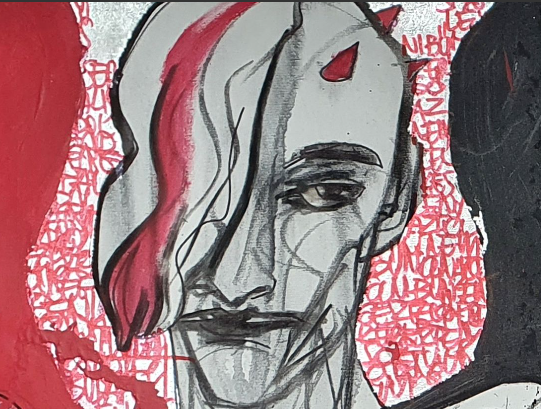
Tamás Menyhárt’s artistic style came to full maturity by the mid-2010s. Although he had produced outstanding works in his earlier periods, the unmistakable characteristics of his painting had by this time become firmly established. The reduced palette, the charcoal reminiscent of cave paintings, the red of blood, the radiance of gold and silver familiar from the Trecento and icons, the dynamic graphic composition, the dripping technique, the restless gestures, and the assemblages of found objects have been present in his paintings ever since. The earlier abstract abstraction has receded into the background; the subject matter is almost always figurative, with, alongside the expressionist depictions of faces and hands, recurring symbols: the skull, the cross, the stigma, halo, bleeding heart, wounding knife, pointing finger, devil’s horns, angel’s wings, beam of light and stardust form Menyus’s primary arsenal. Also featured is the ‘Mantra for Dead Friends’ written by him, which stubbornly reappears time and again as a background element in his paintings.
He creates ‘portraits of the soul’ – either on commission or spontaneously – of his acquaintances. Angels – whether good or fallen – are regular figures in his mythology, but he often paints angel’s wings onto his friends (and indeed onto himself). Occasionally, he also depicts stigmata and halos; the latter have recently taken on a square shape in his work, as the aureola quadrata was, in medieval iconography, the symbol of saints ‘still living’ (e.g. benefactors, patrons). He depicts himself initially as a ‘tourist in hell’, and later increasingly as a temporary inhabitant of hell’s porch: sometimes as a saint, at other times as both an angel and a devil at once. The muses and seraphim are supporting figures in his body of work.
If we are looking for artistic affinities, Schiele and Basquiat spring to mind first. In terms of lifestyle, Modigliani and Soutine. As a Hungarian predecessor, Béla Kondor, whose influence he himself acknowledges. Of his countless deceased painter friends, he recalls the punk-expressionist Lackó Szilágyi and the Dadaist Tibor Bada most fondly, yet feels that, with his own transcendent worldview, he has surpassed their spiritual outlook. In recent years, he has often painted on framed pictures sourced from second-hand markets, reworking and overpainting them with his own iconography, thereby giving them a new lease of life.
Zoltán Rockenbauer, curator
Schedule
///////
Building on the ideas of Daniel Arasse, the 2026 Frissen exhibition explores the Renaissance thesis that a work of art inevitably reflects the individuality of its creator. Although the death of painting has been predicted on numerous occasions – both since the advent of photography and from the perspective of critiques of capitalism – the genre has always been revitalised and strengthened through aesthetic and social self-reflection. The Műcsarnok’s seventh ‘one artist – one room – one curator’ exhibition seeks to answer the question of why artists paint today. This collection of personal exhibitions showcases the diversity of the profession through the latest abstract and figurative works by six Hungarian contemporary painters, brought directly from their studios.
Artist–curator pairs: Ákos Bánki and Szilvia Reischl, Réka Kaszás and Mária Kondor-Szilágyi, Gábor Király and Gréta Garami, Kata Könyv and Réka Fazakas, Tamás Menyhárt and Zoltán Rockenbauer, Katalin Verebics and Anna Blanka Nagy
Kunsthalle Budapest
The largest exhibition hall in Budapest, in Heroes Square, just the opposite the Museum of Fine Arts.