Katalin Verebics | Nautilus Dream (Between Layers) | Fresh 2026

“My main themes – which have also characterised my work to date – are human details, particularly faces, presented in isolated contexts as imprints of personally experienced situations, appearing as emotional gestures, often in a cropped format that can transform them into something surreal. Over the past few years, I have paid close attention to exploring the interplay between the present and the past within a single image, focusing on themes that have most interested me recently.”
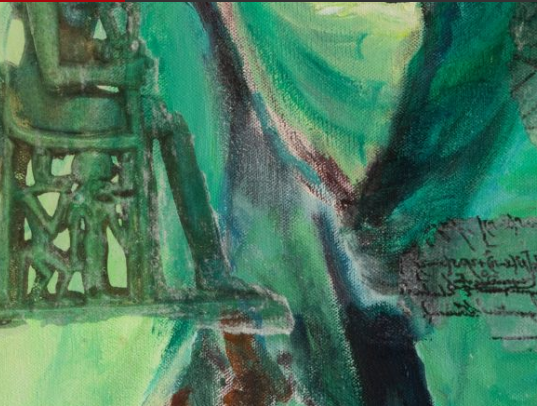
Kati Verebics lives, creates and breathes amongst the layers. In her art, the classical tradition of painting, photography, collage and transfer techniques exist in such a close, inseparable symbiosis that it goes far beyond the mere use of materials. Her paintings do not capture a single isolated moment or static scene, but rather interweave different time frames, cultures, and both subjective and collective memory. Alongside layers of oil, acrylic, charcoal and pastel, papier-mâché, plaster and silt from the River Jordan also feature, giving tangible form to the passage of time.
The dense layering visible in the paintings also shapes the viewer’s experience, which is based on a shift in physical perspective. Viewed from a distance, the canvases present a unified, uncluttered whole. However, as we step closer, the macro-structure breaks down, the view transforms, and the images’ inner micro-universe is revealed. From beneath the surface emerge treasures salvaged from the depths of second-hand bookshops and from travels abroad: the yellowed pages of old medical books, sewing patterns, maps, Bartók sheet music found in an Egyptian market, and fragments of coloured paper hand-dyed by the artist’s husband. In Verebics’ creative process, collage-making is not a premeditated, calculated act. First she tears up the collected papers, then, amongst the pieces, she searches retrospectively for those that seem to belong together.
If we are to understand the roots of Kati Verebics’s art, we must travel back to Dég in Fejér County. Together with her sister, she grew up in a family where culture was a natural part of life. Their mother, an art teacher, and their father, a history teacher and a mayor with a strong sense of local pride, shaped their environment. Their father fought to save the Hollandi House – a former sanatorium for a countess’s daughter – situated next to the Dég castle grounds, and organised contemporary exhibitions there in a unique way. The girls were brought up in this artistic milieu, so the Hungarian University of Fine Arts was almost a natural choice for them.
Kati Verebics’s most frequently used technique, alongside collage, is the transfer technique, which she has been employing since 2015. This is an image-transfer method whereby she incorporates individual photographs into her work, which then become an integral part of the picture. In this way, drawing, painting and photography appear simultaneously on the canvas. The greatest value of this method lies in the fact that it introduces a new, translucent layer into an image created using classical techniques, lending the work a deeper, multi-dimensional space.
His painting is essentially a visual diary in which one can trace his personal emotions, his travels and the events that have befallen him. Yet there is a peculiar contradiction at play here: whilst a diary is, by its very nature, private – something one writes solely for oneself – the artist nevertheless exhibits his paintings to the public. Furthermore, alongside individual experiences, the history of humanity also features in the images. Whilst the paintings capture subjective memory, the materials used in the collages bring collective cultural memory into the pictorial space.
The artist also delights in painting the faces of ancient sculptures seen in museums, in which she recognises the features of her friends and loved ones; it is this association that sparks the creation of the work in her mind. The same personal approach characterises the portraits she has painted of herself and her daughter, Frida. In these, a part of the face is almost always concealed by some kind of plant or natural element – for example, a shell, a pomegranate or a ginkgo leaf. It is this concealment that makes the images both infinitely revealing and elusive: the viewer can glimpse into the personal stories, yet the full reality remains hidden; the image retains the original, secretive nature of a diary.
In recent years, Kati Verebics’s experience of the Siwa Oasis in Egypt and her constant travelling between Budapest and Cairo have become defining features of her body of work. The reason for this dual-residence lifestyle is Kati’s Egyptian husband, who is also a visual artist, and their young daughter. Siwa’s labyrinthine, ruin-like structure, the textile patterns of Bedouin culture and the sacred artefacts in Egyptian museums can all be discovered in the paintings. The working method itself breaks with linearity; the artist often begins painting the works in her Cairo studio, based on photographs and sketches, then folds the canvases into her suitcase and brings them home to complete them in Budapest, working on several paintings simultaneously. Her travels and the world of the lush oasis also bring with them the elemental presence of nature, which takes on a new emphasis in her latest works.
Kati Verebics’s exhibition creates a sanctuary where the clamour of the outside world falls silent. Standing before the pictures, the visitor journeys through the stages of concealment and revelation, until finally reaching the micro-world of the collages. This inner silence and seclusion also surround the artist in her everyday life. Kati currently lives and works in a studio flat atop a church, filled with windows opening onto the sky, where the ringing of bells is not noise but an inspiring background sound for her daily work.
Curator: Anna Blanka Nagy
Schedule
///////
Building on the ideas of Daniel Arasse, the 2026 Frissen exhibition explores the Renaissance thesis that a work of art inevitably reflects the individuality of its creator. Although the death of painting has been predicted on numerous occasions since the advent of photography, as well as from the perspective of critiques of capitalism, the genre has always been revitalised and strengthened through aesthetic and social self-reflection. The Műcsarnok’s seventh ‘one artist – one room – one curator’ exhibition seeks to answer the question of why artists paint today. This collection of personal exhibitions showcases the diversity of the profession through the latest abstract and figurative works by six Hungarian contemporary painters, brought directly from their studios.
Artist–curator pairs: Ákos Bánki and Szilvia Reischl, Réka Kaszás and Mária Kondor-Szilágyi, Gábor Király and Gréta Garami, Kata Könyv and Réka Fazakas, Tamás Menyhárt and Zoltán Rockenbauer, Katalin Verebics and Anna Blanka Nagy
Kunsthalle Budapest
The largest exhibition hall in Budapest, in Heroes Square, just the opposite the Museum of Fine Arts.