Manfred Makra: PLACES – Solo Exhibition at Apollo Gallery

Where Colours Become Space and Paintings Become Inner Landscapes
Some paintings tell stories; others open a gateway to another world. Manfred Makra’s paintings belong to the latter. Delicately layered fields of colour, geometric forms and almost imperceptible transitions give rise to inner landscapes that exist beyond geographical coordinates.
For more than four decades, the Austrian artist has devoted himself to the development of a distinctive pictorial universe. A defining turning point in Makra’s artistic development was his encounter with the Italian painter Antonio Calderara, which marked his decisive turn towards abstraction. His work is rooted in the traditions of twentieth-century geometric abstraction,
Concrete and Constructive art, and Colour Field painting, while exploring the intellectual and spiritual possibilities of line, colour and geometric order. This artistic approach also connects him to the work of Hungarian artist Tamás Konok, with whom he shared a close personal friendship and a belief in the expressive power of the simplest pictorial means.
In Makra’s paintings, colours take on a life of their own. Paint, frequently applied in twenty to twenty-five layers, together with delicate translucent glazes, lends the pictorial surface an extraordinary sense of depth. Geometric forms and subtle colour transitions almost imperceptibly transform the flat surface into a spatial experience. Although his compositions emerge from carefully conceived structures, intuition also plays an essential role: just as one note suggests the next in a musical composition, so the first colour in Makra’s paintings gives rise to the possibilities of those that follow.
The spiritual dimension of Makra’s paintings is enriched by both Japanese art and the tradition of Eastern Christian icons. The refined simplicity of Japanese Noh theatre, with its aesthetics of rhythm and emptiness, resonates throughout his work, as does the understanding of icons as passages between the visible and the invisible. Makra’s artistic thinking also engages with the philosophical questions surrounding Gottfried Boehm’s iconic turn: how can an image generate meaning through its own visual means, and how does that meaning unfold through the act of contemplation?
The exhibition PLACES invites visitors to step beyond the hurried rhythms of everyday life and allow themselves the time to truly see. Through slow, attentive contemplation, Makra’s paintings become spaces in which the viewer’s own memories, emotions and thoughts may resonate. As the artist reflects in his thoughts written for the exhibition, what we seek in a work of art is often nothing other than that place within ourselves which we have lost amid the noise of the world.
Exhibiting artist: Manfred Makra
Exhibition curator and author of the text: Krisztina Kovács
Assistant curator: Eszter Hannya, Marcella Koczkás
Opening remarks by: Fabian Ortner, Director of the Austrian Cultural Forum Budapest.
Graphic design: Nóra Kaszanyi, Adrienn Császár
At the opening, with the support of Papageno, pianist Péter Kiss will perform two preludes by Claude Debussy: The Sunken Cathedral (La cathédrale engloutie) and Minstrels. The distinctive tonal palette and atmosphere of Debussy’s music enter into a subtle dialogue with Manfred Makra’s paintings.
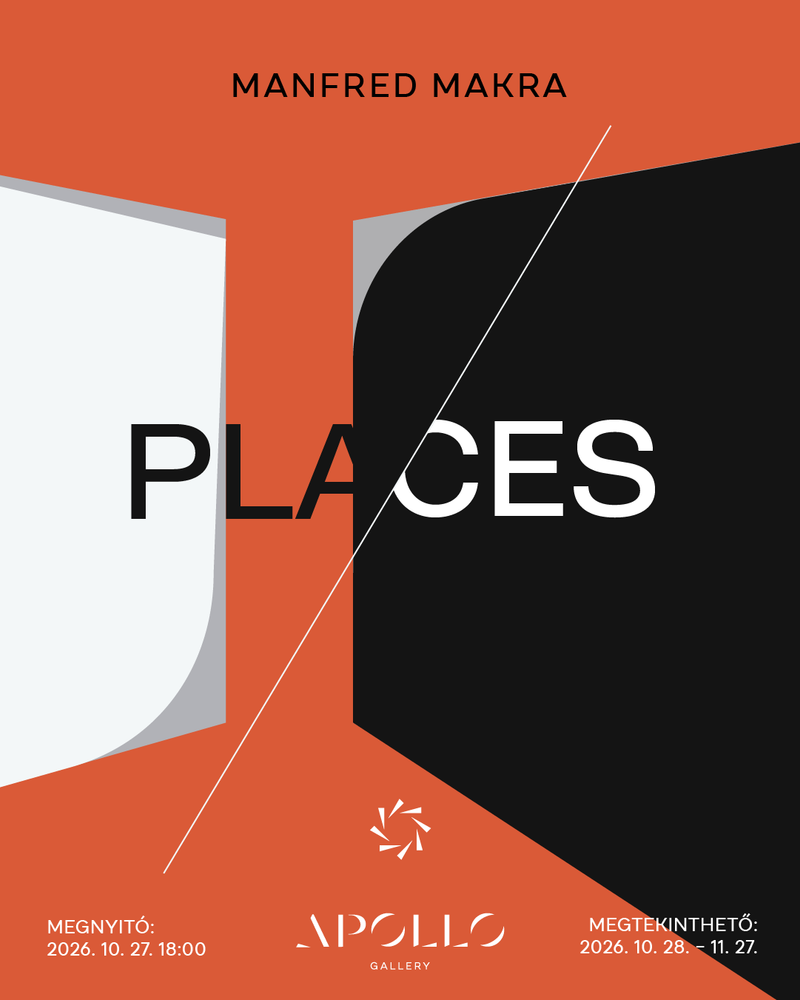
Opening: October 27, 2026, 18:00
Venue: Apollo Gallery, entrance from Stáhly Street, 1085 Budapest, Blaha Lujza tér 1
The exhibition will be on view from October 28 to November 27, 2026, during the gallery’s opening hours.
Schedule
Where Colours Become Space and Paintings Become Inner Landscapes
Some paintings tell stories; others open a gateway to another world. Manfred Makra’s paintings belong to the latter. Delicately layered fields of colour, geometric forms and almost imperceptible transitions give rise to inner landscapes that exist beyond geographical coordinates.
For more than four decades, the Austrian artist has devoted himself to the development of a distinctive pictorial universe. A defining turning point in Makra’s artistic development was his encounter with the Italian painter Antonio Calderara, which marked his decisive turn towards abstraction. His work is rooted in the traditions of twentieth-century geometric abstraction,
Concrete and Constructive art, and Colour Field painting, while exploring the intellectual and spiritual possibilities of line, colour and geometric order. This artistic approach also connects him to the work of Hungarian artist Tamás Konok, with whom he shared a close personal friendship and a belief in the expressive power of the simplest pictorial means.
In Makra’s paintings, colours take on a life of their own. Paint, frequently applied in twenty to twenty-five layers, together with delicate translucent glazes, lends the pictorial surface an extraordinary sense of depth. Geometric forms and subtle colour transitions almost imperceptibly transform the flat surface into a spatial experience. Although his compositions emerge from carefully conceived structures, intuition also plays an essential role: just as one note suggests the next in a musical composition, so the first colour in Makra’s paintings gives rise to the possibilities of those that follow.
The spiritual dimension of Makra’s paintings is enriched by both Japanese art and the tradition of Eastern Christian icons. The refined simplicity of Japanese Noh theatre, with its aesthetics of rhythm and emptiness, resonates throughout his work, as does the understanding of icons as passages between the visible and the invisible. Makra’s artistic thinking also engages with the philosophical questions surrounding Gottfried Boehm’s iconic turn: how can an image generate meaning through its own visual means, and how does that meaning unfold through the act of contemplation?
The exhibition PLACES invites visitors to step beyond the hurried rhythms of everyday life and allow themselves the time to truly see. Through slow, attentive contemplation, Makra’s paintings become spaces in which the viewer’s own memories, emotions and thoughts may resonate. As the artist reflects in his thoughts written for the exhibition, what we seek in a work of art is often nothing other than that place within ourselves which we have lost amid the noise of the world.
Exhibiting artist: Manfred Makra
Exhibition curator and author of the text: Krisztina Kovács
Assistant curator: Eszter Hannya, Marcella Koczkás
Opening remarks by: Fabian Ortner, Director of the Austrian Cultural Forum Budapest.
Graphic design: Nóra Kaszanyi, Adrienn Császár
At the opening, with the support of Papageno, pianist Péter Kiss will perform two preludes by Claude Debussy: The Sunken Cathedral (La cathédrale engloutie) and Minstrels. The distinctive tonal palette and atmosphere of Debussy’s music enter into a subtle dialogue with Manfred Makra’s paintings.
Opening: October 27, 2026, 18:00
Venue: Apollo Gallery, entrance from Stáhly Street, 1085 Budapest, Blaha Lujza tér 1
The exhibition will be on view from October 28 to November 27, 2026, during the gallery’s opening hours.
Apollo Gallery
APOLLO is a unique cultural hub and art space, where all can discover outstanding Hungarian and international contemporary art. The gallery represents influential art through thoughtfully curated exhibitions of established and emerging artists.