Gábor Király | On the Blue Horizon | Fresh 2026

Gábor Király’s latest exhibition captures a moment of creative transition – an open-ended turn towards the unknown – in which the artist’s earlier raw expressiveness gives way to a more disciplined, lyrical and meditative visual language.
For a long time, Király’s painterly universe presented us with a uniquely unsettling, contradictory visual world, in which figures with stiff, paralysed hand movements, broad shoulders and rough-featured faces appeared as bearers of disharmony. His characters – circus performers and harlequins in patterned, sleeveless leotards and Dutch caps with donkey ears – embodied unsparing candour, as well as absolute creative freedom that stood outside social conventions and the rules of politeness. The visual world of the scenes evoked the absurd humour and profound moral criticism of the old Flemish masters, where, behind the animalistic aspects of the figures, our human frailties are revealed in a self-ironic, satirical distorting mirror.
His most recent works, however, bear witness to a shift in perspective, marking a new direction in his oeuvre at both the formal and conceptual levels. Moving away from his earlier mode of representation, which was built upon the dynamics of ugliness, the artist’s current phase unfolds in two seemingly contradictory yet complementary directions: towards lyrical blue landscapes verging on monochrome, and towards colourful interiors organised around the idea of order. In these two parallel worlds, the artist explores the harmony between the external reality of existence and the inner reality of the individual. In every instance, behind the figure placed on the stage and the blue horizon, there looms a sense of tragedy, existential-ontological depth and the inevitable loneliness of human existence.
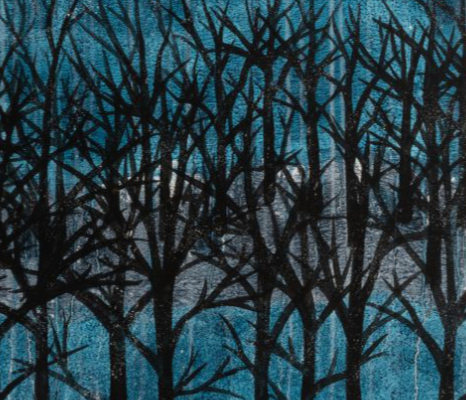
The landscapes shrouded in a blue-grey mist create a stark yet poetic rendering of nature: timeless, dreamlike spaces filled with melancholy and silence. At the same time, the visual narrative is permeated by a deep sense of anxiety. Although the dignified deep-blue hue of the vast expanse of water surrounding the solitary figure suggests tranquillity, the setting presents an apocalyptic scene. On the canvas, the paint trickles down like weeping rain; the flood engulfs everything, whilst amongst the trees, burnt black and parched, the figure gathers food entirely alone. The menacing monumentality of the floodplains, nature’s ambivalent embrace and the figure’s Sisyphean struggle – as he defies the all-encompassing floodwaters on an isolated patch of land to protect the tiny creatures of the vegetation – suggest, alongside an ecological reflection on the present, that we are in fact traversing mental landscapes, deep within the soul.
This internal tension is further amplified by the technical execution. The rustic character and archaic nature of the coarse-woven sackcloth, the disruption and unravelling of the layers, the mixing of chemically incompatible substances – such as water and oil – and the use of plaster to create earthy tones, graphite and charcoal – all create an impression of randomness, the dimension of time and a sense of evoking memories in the viewer.
The painter dilutes the so-called Payne’s grey and applies it to the surface in a veil-like manner: rather than concealing it, he ‘washes over’ the support, so that the material of the painting – the coarse canvas itself – becomes part of the landscape, its fibres and the warmer undercoats beneath it subtly shining through the transparent layer of paint. It is not only the textural effects of this new painting technique that are exciting, but also the quality of the imagery it evokes: the interplay of various shades of blue and grey simultaneously conveys a frosty tranquillity, the cosmic depth of the night sky and the peace of the dawn twilight.
In contrast to this open landscape, stretching into the unknown, the interior spaces present a box-like, enclosed system, creating visual metaphors for the clash between free, instinctive existence and the regulated world. The intimacy of the spaces is underpinned by classic motifs from the history of painting: the perspectival floor, the symbolic furniture, an object held in the hand, the window opening onto the landscape, and the dog appearing as man’s faithful companion. The architectural details of the space – the floor, the table, the window sill – however, follow a clearly structured, austere, angular order. This cool, geometric regularity stands in sharp contrast to the natural and raw forms of the figure, the dog and the outside world filtering through the window – everything that has characterised the artist’s work to date. Yet an extraordinary, meditative tranquillity emanates from the paintings. It is precisely this tension that preoccupies Gábor Király: how the wildness of an organic figure or landscape can be reconciled with the discipline of space – that is, how our innermost, animal-derived, tragicomic and contradictory human traits can be reconciled with the frameworks of our rationalised lives.
Gábor Király’s new works, organised into a system and striving for harmony, are peculiar syntheses of man’s existential loneliness and the persona he presents to the outside world, where the individual’s true, authentic inner self and the face he shows to external reality are brought into balance. His figures are less wild; they do not strike poses, nor do they wear frightening, mask-like faces; their hands no longer twitch in chicken-leg-like spasms – they do not flee from loneliness into false social roles, nor do they stand in wild defiance against the outside world: they look out upon the world from a solid inner core.
His latest works bear witness to a creative attitude that regards art not as a fixed truth, but as a continuous search for direction, running parallel to the maturing of the personality. The strength of his creative approach lies in his open embrace of the process of experimentation and the vulnerability inherent in transience. Behind the evolution of her compositions, however, the classical painterly ethos pulsates throughout: the striving to depict her inner vision at the highest level, to shape aesthetic truth and artistic self-identity, that is, to achieve authenticity.
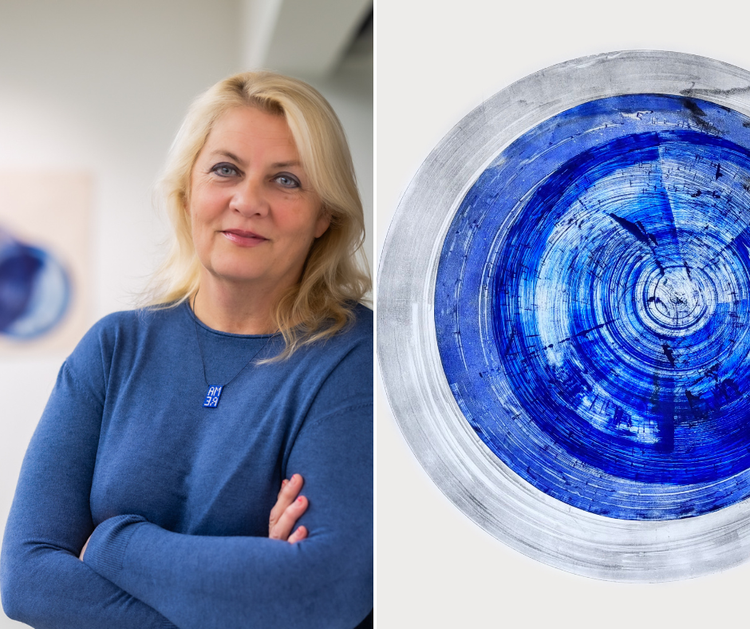
Gréta Garami
curator of the exhibition
Schedule
Building on the ideas of Daniel Arasse, the 2026 Frissen exhibition explores the Renaissance thesis that a work of art inevitably reflects the individuality of its creator. Although the death of painting has been predicted on numerous occasions – both since the advent of photography and from the perspective of critiques of capitalism – the genre has always been revitalised and strengthened through aesthetic and social self-reflection. The Műcsarnok’s seventh ‘one artist – one room – one curator’ exhibition seeks to answer the question of why artists paint today. This collection of personal exhibitions showcases the diversity of the profession through the latest abstract and figurative works by six Hungarian contemporary painters, brought directly from their studios.
Artist–curator pairs: Ákos Bánki and Szilvia Reischl, Réka Kaszás and Mária Kondor-Szilágyi, Gábor Király and Gréta Garami, Kata Könyv and Réka Fazakas, Tamás Menyhárt and Zoltán Rockenbauer, Katalin Verebics and Anna Blanka Nagy
Kunsthalle Budapest
The largest exhibition hall in Budapest, in Heroes Square, just the opposite the Museum of Fine Arts.