
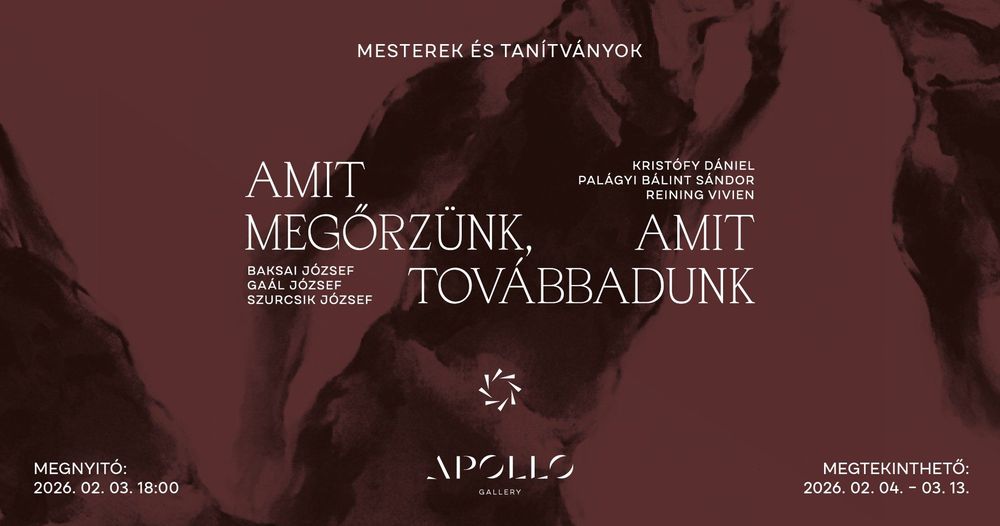
WHAT WE PRESERVE, WHAT WE PASS ON
2026-02-03T23:00:00.000Z - 2026-03-12T23:00:00.000Z

Masters and disciples
Feb
03
Mar
12
Schedule
One of the most important characteristics of artistic learning is that a significant part of its knowledge cannot be articulated in its entirety. It cannot be written down in rules, recorded in methodologies, or conveyed purely in the form of instructions. In the visual arts, most learning takes place as implicit knowledge: a combination of experiences, sensibilities, and decision-making mechanisms that can only be formed through practice, shared time, and shared attention.
Michael Polanyi describes implicit knowledge as something that "we know but cannot fully articulate." This knowledge is not found in the explicit curriculum, but in movements, emphases, the rhythm of feedback, and the quality of questions. In this sense, the master-apprentice relationship is not about imparting knowledge, but about acquiring a way of seeing. In the tradition of fine arts, the master is not primarily an authority figure, but a point of orientation. His presence does not close, but opens: he does not give ready-made answers, but teaches us to live with uncertainty. There are thinkers who believe that seeing is not passive reception, but an active relationship with the world—the artist does not paint what he sees, but how the world becomes visible to him. This "how" cannot be learned directly; it can only be experienced, acquired, and then further reflected upon.
This exhibition examines this complex, multi-layered process through the relationship between three masters and three students. Instead of focusing on stylistic similarities and formal echoes, attention is directed toward the invisible knowledge that operates behind the works. Here, inheritance appears as transformation: the received approach is present in the student's work not as a memory but as active material. The students featured in the exhibition were selected by the masters: not on the basis of representational criteria, but on the recognition that they see the artistic approach they themselves once developed living on and transforming in them.
The placement of the exhibited works is a dramaturgy composed for dialogue. The two spaces speak with different emphases, yet they are intertwined: the masters' works appear among the students' works, and some of the students' works are placed alongside those of the masters. This gesture does not blur the lines, but rather makes visible the common origins and moments of becoming independent.
The works and text fragments of the masters are primarily displayed in Exhibition Hall 1. These statements are not technical descriptions, but fragments of life stories: answers to the question of why someone chooses art as a life's work, how the inner necessity that sustains creation in the long term develops, and when this experience becomes transferable, at least in part.
Tradition here is not understood as fixed content, but as a space in which thought is set in motion and in which a career path becomes visible not as a closed whole, but as a process.
In Exhibition Hall 2, the works of the students are brought to the fore, while the reflections of the students and their masters can be read side by side on the walls. This juxtaposition creates a dialogue: it becomes visible how an artistic voice becomes independent without denying its point of departure. The works borrowed from the masters do not represent a step backward, but rather continuity: a sign that learning and teaching are not successive stages, but states that operate in parallel.
In this sense, teaching is not control, but accompaniment: an attentive presence that provides security and leaves room for risk. The mixing of spaces visually reinforces this idea: the works are not "put in their place," but enter into a relationship with each other, revealing similarities, differences, shifts, and moments of independence.
Attention is one of the most profound ethical gestures. It is not possession, but rather turning toward. The essence of the master-disciple relationship can be grasped in this quality. In that teaching is not a prescription, but a jointly undertaken risk, the risk that the disciple will ultimately arrive somewhere other than where the master ever arrived.
The title of the exhibition—What We Preserve, What We Pass On—refers to this duality. To the tension that underlies every creative process: the simultaneity of holding on and letting go, of remembering and starting over. In this sense, art is not a system of answers, but a question that constantly reopens itself. How can we remain faithful to what we have received and yet take responsibility for what becomes visible in us?
Location
Apollo Gallery
APOLLO is a unique cultural hub and art space, where all can discover outstanding Hungarian and international contemporary art. The gallery represents influential art through thoughtfully curated exhibitions of established and emerging artists.
Similar Events



Telekom Spots is an open event listing platform where anyone can upload their own events for free. Telekom is not the organizer or sponsor of the events, unless explicitly stated for a specific event.