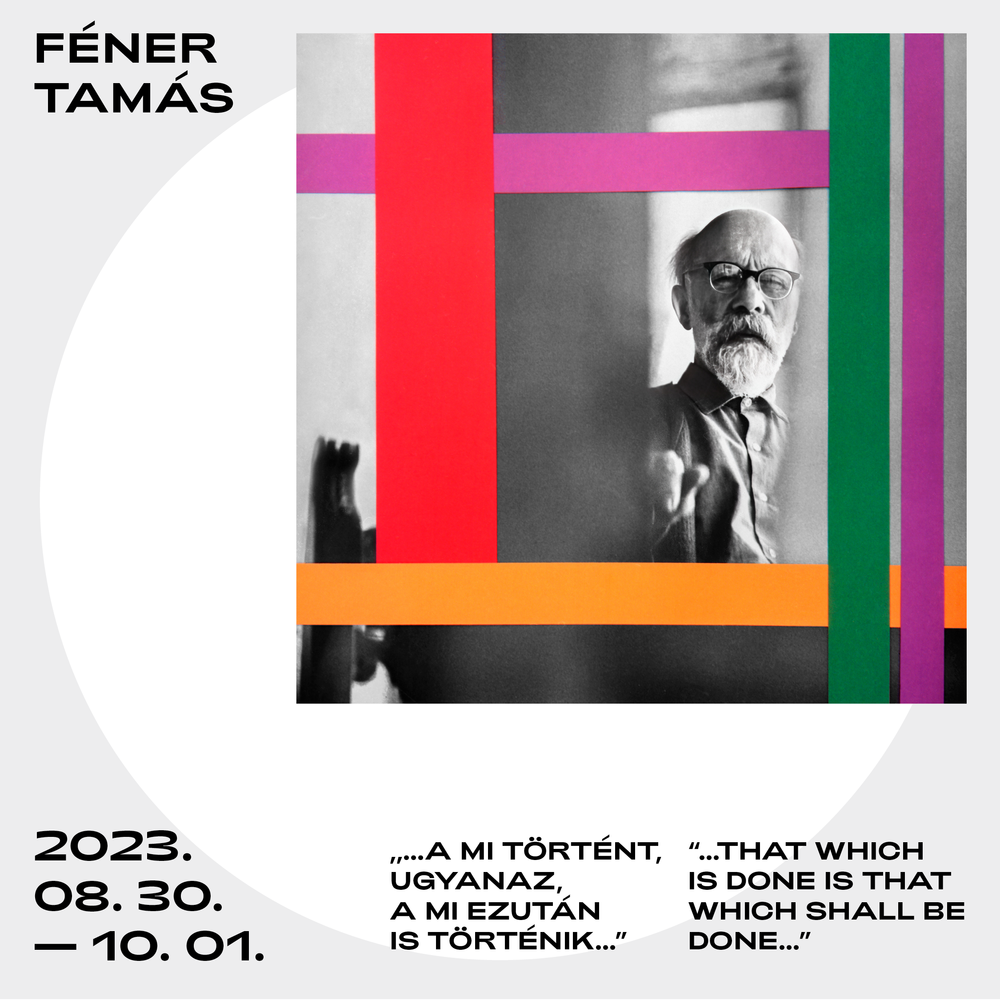
Tamás Féner: „...that which is done is that which shall be done...”

Tamás Féner is a leading figure of contemporary Hungarian photography. His career has spanned historical periods, and his influence is noticeable in the works of subsequent generations to this day.
Schedule
The creative period that lasted until the regime change was marked by the attitude of the photojournalist, with generations raised on his classic photo stories. Opened in 1983 and presenting what was perhaps his most successful series in the period,* ‘...and tell your son...’ *was an exhibition that proved to be a milestone in generating an understanding of Budapest’s post-world war Jewish community. Staged at the Museum of Ethnography, the display was first banned, only to reopen again, and the photo series was published in a multilingual album. He was also an innovator of the genre of the photo feature, with each of the series on oil miners and the Cserhalmi team of miners, as well as the colour series 1400° and Mirror Flight, or the tilted land- and cityscapes, bringing about some turn in Hungarian photography. Along with his photographic oeuvre, Tamás Féner has also set an example for his contemporaries with decades’ worth of organizational work. As the Secretary General of the Association of Hungarian Photographers, he initiated the establishment of the Studio of Young Photographers, which continues to be the most important organization for young contemporary photographers. He was a lecturer at several universities and his students are now also important figures in contemporary photography. In a career of almost seventy years, he proved to be capable of constantly reinventing his art, because almost every new series signalled a turning point in his creative thinking. The exhibition ‘… that which is done is that which shall be done...,’ whose title is taken from the Bible, both reflects Tamás Féner’s outlook on life, and offers a summary of his most recent creative period, whose latest chapter has unfolded this year. Objects, often ones used as, or assumed to be, sacral, as well as texts, dominate the various series of the last decade, and they sometimes occasion a look at religion. Later, with a new change of direction, he introduced works whose manner approached the painterly, and offered his reflection on subjectless—digitally generated—images with ones created in the most traditional manner.
Occupying four rooms, the exhibition presents three series: *Symbol Fishing *(2015), Jacob’s Ladder (2018); And Repeat (Babits) and Architectures (both 2022–2023). The latter two are divided into two chapters and are shown in two rooms. In most cases, the artist does not support his images with captions that would limit the associations. The colour portraits are reinterpretations of photos made years or even decades earlier, while the constructivist compositions unfold motifs carried over from earlier times.
The exhibition also presents another layer of interpretation, in that in the plane beneath the images of recent years, black and white and colour traces of older series appear, suggesting the ideas behind the series that were the conceptual antecedents of the images in the main body of the exhibition.
Hungarian House of Photography - Mai Manó House
Mai Manó House – The Hungarian House of Photographers – operates in a studio-house built at the end of 19th century, for the commission of Mai Manó (1855-1917), Imperial and Royal Court Photographer. This special, eight-story neo-renaissance monument is unique in world architecture: we have no knowledge of any other intact turn-of-the-century studiohouse. In addition, it serves its original goal, the case of photography again.
The aim of Mai Manó House is to advance the development of Hungarian photography and raise photography’s national prestige as a distinct form of art.
The institution plays a marked role in the cultural life of Budapest and Hungary, while the organization of exhibitions and programs abroad is getting more and more emphasis within its activities. The reputation of justly world-famous Hungarian photographers of the 20th century offers a great opportunity to regain our old status in the world of photography by the introduction of the generations following those great masters