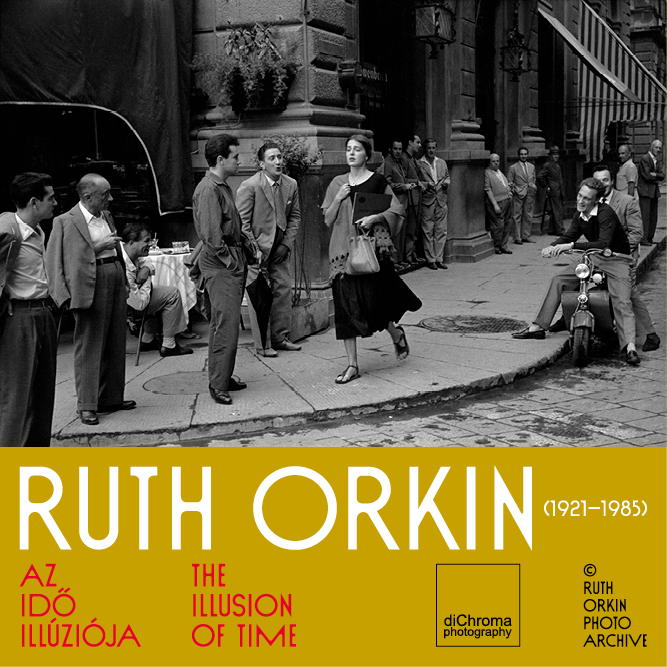
The Illusion of Time – Ruth Orkin (1921 – 1985)

Pursuing a career as a filmmaker in the United States during the first half of the 20th century was an obstacle course for women. Women were engaged in feeding the factory of dreams, but not in making them, which meant that all careers behind the camera were unquestionably earmarked for men. Ruth Orkin (Boston, September 3, 1921 – New York, January 16, 1985) had to renounce her vocation, or at least redirect and transform it, and this setback would perhaps lead to definitively shaping her photographic work.
Schedule
Orkin was the only child of Mary Ruby, a silent-film actress, and Samuel Orkin, a manufacturer of toy boats called Orkin Craft, and she grew up in Hollywood in the heyday of the 1920s and 1930s. She received her first camera, a 39-cent Univex, at the age of ten. Though she did start to take photos, Ruth Orkin’s real passion was for the moving image, for filmmaking.
She worked for a while as a messenger at Metro Goldwyn Mayer, moving quickly from one department to another and yet taking the time to let her eyes wander and learn many things that she would constantly put into practice in her still images. She was simultaneously studying photojournalism at Los Angeles City College in the early 1940s and embarked on a career as a reportage photographer for major illustrated magazines such as LIFE, Look and Ladies Home Journal, among others.
But what would remain always implicit in her work was her fascination with the heuristic power of cinema. And it was this lost opportunity to follow her vocation that would compel Orkin to work within its margins and invent a language at the juncture of the two genres, a language that lies in a middle ground between the moving and the still image, thereby leading to an ongoing correspondence between two parallel temporalities.
If we analyse Orkin’s work, it is evident that the ghost of cinema—which appears in a variety of forms from the outset of her early images—slithers into the tiny cracks of the frame to create a dual depth in the image, in which the flow of movement begins its tempo: a spark, an imprint that encloses a “filmic or duration effect,” a simulated duration which is like one of cinema’s invisible tricks, for is not film ultimately the art of movement produced from stillness?
To simulate film, Orkin strove to combine the temporal characteristics of the photographic image. Sequences, the decomposition of movement, duplication and simultaneity: her visual language lies at the juncture of the photographic image and cinema, at the crossroads of stillness and movement. Her photography is a melting pot, a space that restores time and movement, pushing photographic language beyond its limits until it yields to the power of illusion and magic.
Anne Morin
Hungarian House of Photography - Mai Manó House
Mai Manó House – The Hungarian House of Photographers – operates in a studio-house built at the end of 19th century, for the commission of Mai Manó (1855-1917), Imperial and Royal Court Photographer. This special, eight-story neo-renaissance monument is unique in world architecture: we have no knowledge of any other intact turn-of-the-century studiohouse. In addition, it serves its original goal, the case of photography again.
The aim of Mai Manó House is to advance the development of Hungarian photography and raise photography’s national prestige as a distinct form of art.
The institution plays a marked role in the cultural life of Budapest and Hungary, while the organization of exhibitions and programs abroad is getting more and more emphasis within its activities. The reputation of justly world-famous Hungarian photographers of the 20th century offers a great opportunity to regain our old status in the world of photography by the introduction of the generations following those great masters