

Schedule
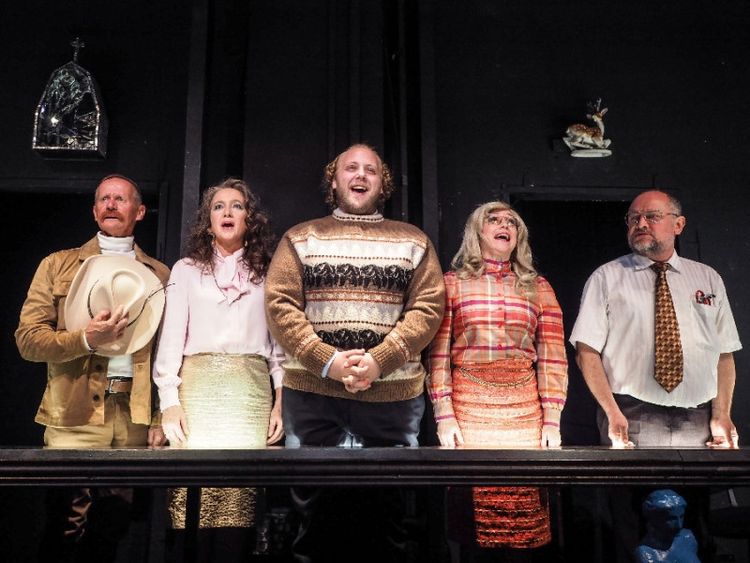
A hilarious village farce, a stage version of Sándor Rideg's novel "The Bacteria House is Starting". A band of fire-fighting orchestral brass will blow the tune in the theatre, and the performance will include a burlesque-like chase, a run this way, a flight that way, a look under the skirt, a peek into the pot. And the ghost of the house, a ghostly ghost of the house, will appear in the attic of the decaying bacteria house to give the plot new and fresh impetus.
The adolescent boy, Bendegúz Regős, who has never succeeded at anything in his life and of whom the only thing people remember is: "I wish they had hanged you when you were two days old", is left out of school and his mother hires him out as a cowherd with the help of a clutch.
That's how he ends up with the harami-faced Bacter Szabo, who has to graze the cows by the railway. But even though Bendegúz is a well-intentioned boy, he is usually "in trouble" by the time he has "finished his purpose...". The figure suffers many humiliations, even if he has the sense to keep his wits about him. But his good humour never fails him. On the outskirts of Vecsés and Ferihegy, to fatten up the cows, he is forced to graze in a forbidden area, which earns him a good deal of stick from the peasants. But his life is made worse by his bacterial mother-in-law, the Stinky Witch, who turns even clean water into vinegar in his mouth. She is as flat as a flame from the front and as curvy as St. Gellert's Hill from the back.
The story, which is being told on the stage of the Hevesi Sándor Theatre, has become a favourite of generations for a reason.
Length of performance: 2 hours 10 minutes (with one break)
József Attila Theatre
The József Attila Theatre is a theatre in Budapest, in the 13th district, at 63 Váci út. In 1955 it became the József Attila Theatre. The building was originally intended to be a house of culture, previously it was used as an operetta theatre by the Déryné Stage and later by the Hungarian People's Army Theatre Chamber Theatre. It became independent in 1956.