Ákos Bánki | SEQUENCES | Fresh 2026

Ákos Bánki was born into an ideal environment, a circumstance owed equally to the atmosphere of his childhood in Kazincbarcika and Miskolc – that unfathomable yet unfulfilled void, which would inevitably bear fruit later on – and to Sándor Szerdahelyi, the master teacher who ensured he mastered the fundamentals of the science of representation.
The embodiment of this void, the object of his desire, soon became objectivity – the depiction of reality par excellence arising from the coexistence of the tangible, the visible, and that which is not, or only with difficulty, perceptible.
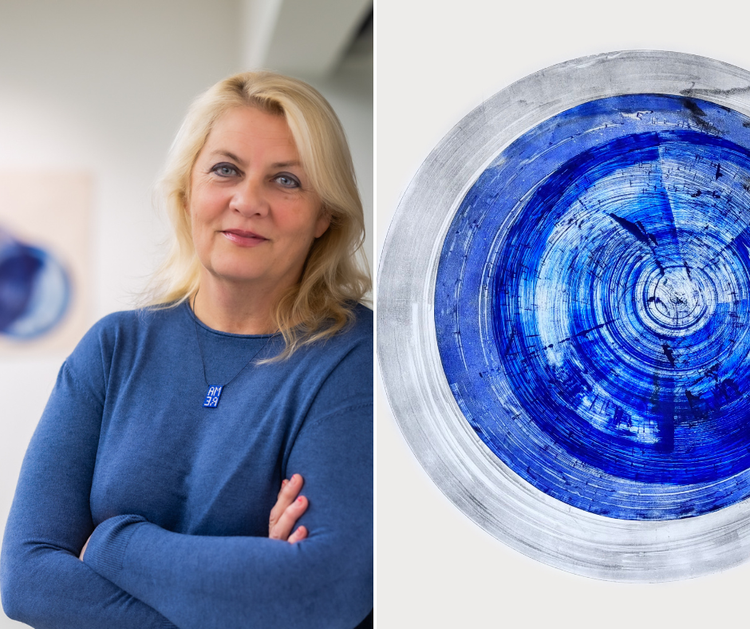
An analysis of eternal truths takes place within the paintings and during their creation – a combinatorial process involving the superimposition of layers, the masterful harnessing of their interactions and their often unpredictable physical and chemical mechanisms, reinforced by the tangible thickness created by the layering and the living, organism-like variability of this expanse, thereby affirming that matter, too, has its place alongside the spirit.
Influenced by the Zugló Circle, and indirectly by the Paris Schools and the works of Tamás Lossonczy, and naturally yielding to his own desire for freedom, Bánki abandoned figurativeness – the direct representation of the natural and built environments – and later also the practice of providing a clear point of reference for abstraction. This is a risky move, as many people dismiss the works outright for this very reason; yet for those who are willing to engage directly with the images, it offers the opportunity to experience something universal—an experience unique to humanity—that transcends impersonality.
The works on display in this exhibition, created in 2023 and for the most part in the few months leading up to the exhibition, are milestones in the necessary, consistent research that Bánki has been pursuing for twenty years. He thinks in terms of sequences and series, where each cycle – sometimes featuring subtle overlaps – stems from and leads to an experience, and we need as many such experiences as possible to feel, from time to time, that our struggle with the elements of existence is fruitful. Mapping out countless perspectives, processing changes and abstracting all of this poses no difficulty for him, partly due to the influence of Sándor Molnár, Orsolya Drozdik and Tamás Lossonczy, and partly thanks to the worldviews of artists he has come to know solely through their works, including Sándor Weöres, Béla Hamvas and, of course, Tibor Hajas, Mark Rothko, Hermann Nitsch, Otto Mühl and Arnulf Rainer, or the great American female painters: Joan Mitchell and Pat Steir.
In the abstraction of colours and in his latest works—rich in colour and transforming into passageways between spaces and time planes—one finds the photographic conception of the immortal moment, the tradition of American Expressionism, and Rothko-esque virtuosity. We are treated to exceptional experiences: through contemplation, the world can be condensed within us.
Her earlier series also enable us to experience this emotionally rich state: the playful cosmoses of *Melancholy* (2013), the crisp petals and intricate structures of *Soul Flowers* (2011–), the X-ray-like, stripped-back images of body and spirit in *Psychic Space* (2006–), the chaos organised by the colours tinged with white in *Dionysus* (2009–) with its chaos organised by colours tinged with white, the colourful splendour of *Barcelona* (2020) demonstrating rebirth, and the quasi-summary visible in the pieces of the *Flumen* series (2021–).
The appeal of the paintings lies in the artist’s self-transcendence and, as a consequence, his continued presence within the image – a factor to which the human-sized canvases, with their dimensions allowing for back-and-forth interplay and even symbiosis, clearly contribute, despite the painter’s absence in physical form. It is not only the hand and the head that struggle to crystallise and capture the vision – the whole body is part of the flow of energy. A struggle is underway with the material, with the magic of the indefinable number of dimensions of colours and colour combinations – colours mixed on the basis of definition and imagination, and converted into form.
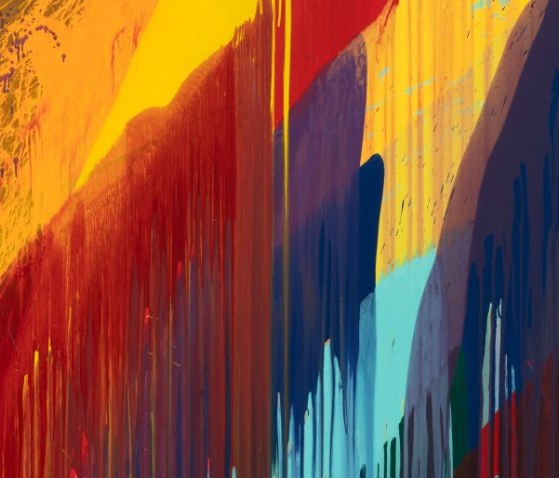
The structure of the latest series, entitled ‘Sequences’, follows this expressive and meditative path of hers to date. Active resistance and insight are present together in these structures, which are built in an almost Babel-like manner and which, once again, extend beyond the frame – they seek to explore even those areas that, in theory, lie outside it. The colour bands – whether clearly defined or blurred – are applied to the canvas in a specific sequence, and then, as a culmination, a final gesture – reminiscent of Nitsch’s submersion and arising from the very last stroke – weaves together the entirety of the moment.
This projection, situated at the very bottom of the picture, becomes the essence of the painting – there lies the fantastical nature of the absolutely complex event. An abstraction that presents the necessary knowledge to us in condensed form, whilst also reminding us of the background required for this knowledge, so that as we reach the point of repose, we feel the rendering of that particular sequence taking place within us.
The nine paintings set within the semicircular apse and the single Flumen image visible on each of the side walls are each a call-up. The painter does not call up data, but a state of being, and the acoustics will be perfect when we take our place at the centre, close the circle of enchantment, and become the twelfth element ourselves—the principal work—whilst the paintings achieve their effect by setting aside the orgy that has now become superfluous.
This light solitude, enveloped by the spectacle, is a training ground for the later state of being alone and the even later state of being left entirely to oneself. The preparatory show.
Szilvia Reischl, curator
Schedule
///////
Building on the ideas of Daniel Arasse, the 2026 Frissen exhibition explores the Renaissance thesis that a work of art inevitably reflects the individuality of its creator. Although the death of painting has been predicted on numerous occasions – both since the advent of photography and from the perspective of critiques of capitalism – the genre has always been revitalised and strengthened through aesthetic and social self-reflection. The Műcsarnok’s seventh ‘one artist – one room – one curator’ exhibition seeks to answer the question of why artists paint today. This collection of personal exhibitions showcases the diversity of the profession through the latest abstract and figurative works by six Hungarian contemporary painters, brought directly from their studios.
Artist–curator pairs: Ákos Bánki and Szilvia Reischl, Réka Kaszás and Mária Kondor-Szilágyi, Gábor Király and Gréta Garami, Kata Könyv and Réka Fazakas, Tamás Menyhárt and Zoltán Rockenbauer, Katalin Verebics and Anna Blanka Nagy
Kunsthalle Budapest
The largest exhibition hall in Budapest, in Heroes Square, just the opposite the Museum of Fine Arts.