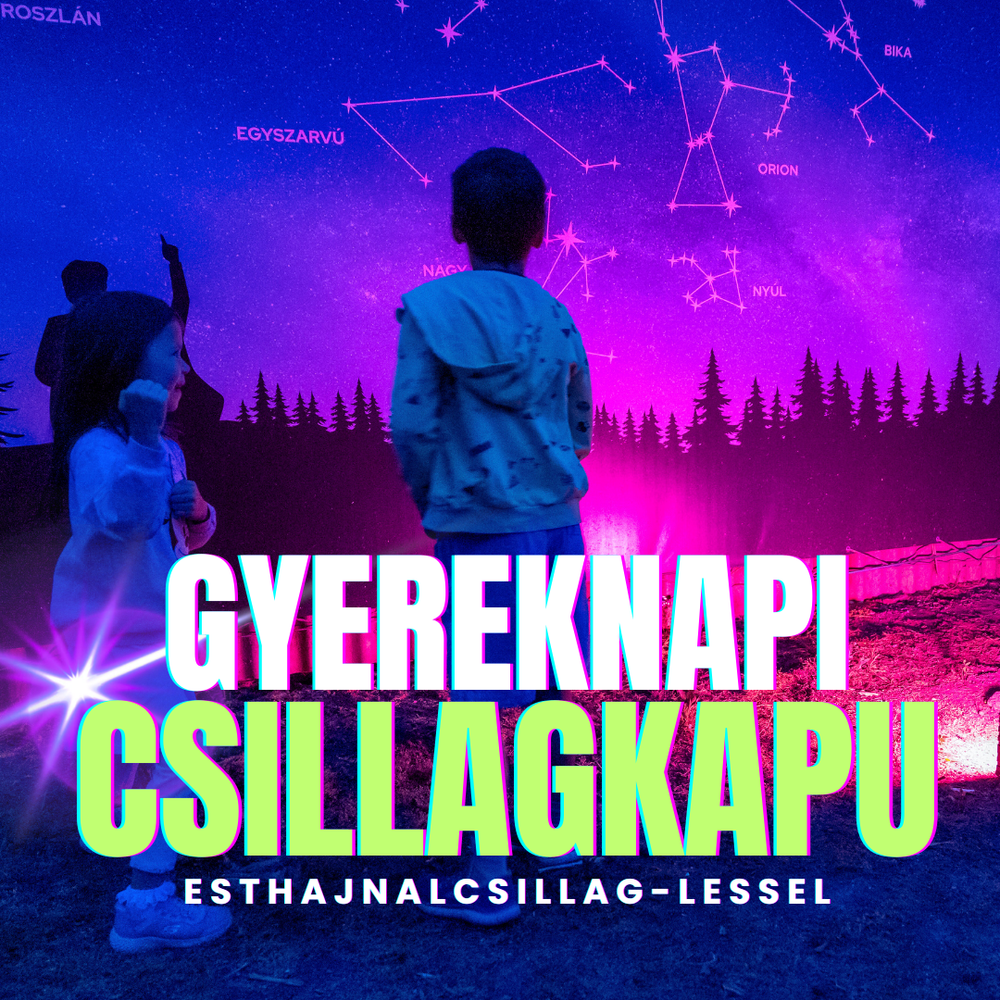
Children's Day Stargate, with the Evening Star - May 30.

At our Children’s Day Star Gate, fun children’s activities await during the day, and as evening falls, the Evening Star, the full moon, and other beautiful planets will be visible through our telescopes!
We’ll cook a smoking comet nucleus using cosmic ingredients. We’ll model the structures of the Universe with giant bubbles on the green lawn. We’ll launch planets into orbit on the Space-Time Trampoline and handle meteorites in the meteorite petting zoo.
Schedule
Venus is currently best seen in the evening sky, but alongside it, the ringed craters of the full moon, Jupiter’s cloud bands, and the tiny planetary spectacle of Mercury also await us. Indeed, this year the heavens are treating children—and adults, of course—to a truly extraordinary planetary parade!
Stargate: Amid the excitement of our major astronomy event, the program venues at the Svábhegy Observatory can be explored freely at your own pace. It’s worth buying tickets online in advance, but tickets are always available for purchase on-site as well.
Programs
Daytime Astronomy:
Solar Observation: We’ll examine the sunspot-rich surface and atmosphere of the Sun. We’ll marvel at the structure of sunspots, fountain-like solar flares, and solar prominences. Multiple solar telescopes will be trained on the sky, revealing our star in a dazzling array of colors.
Twilight Planetary Parade
Evening Star, or Venus: this easily observable planet is currently in its 80% illuminated phase. Even its polar caps and cloud bands may be visible on its small, brightly glowing disk.
Jupiter: Look for this massive, elliptical giant planet in the twilight sky, with its ruffled, straight cloud bands.
Mercury: This tiny, grayish-pink planetary phenomenon is a true rarity, with a phase of 73%. On its disk dancing in the atmosphere, those with the sharpest eyes may even catch a glimpse of surface details.
Interactive astronomy programs
Meteorite examination: Get your hands on rocks from space!
Spectrum Zone: Light experiments in every color of the rainbow!
Planet Sniffing: Get ready for some deep breaths!
Comet Cooking: We’ll cook up a smoking comet nucleus!
Space-Time Trampoline: Put the planets into orbit around the Sun!
Telescope Tricks: We’ll take it apart, cut it in half, look inside, and focus it...
Bubble Universe: Giant colorful bubbles and their astronomical connections
Constellation Puzzle: You’ll be one of the stars in the sky!
...And even more surprises....
Nighttime Telescope Observation
Full Moon: On the vast disk of the late-spring full moon, we can admire the thousand-kilometer-wide rays of the rayed craters, the dark lunar seas, and the bright, jagged ridges of the mountain ranges.
The most beautiful spring double stars: Mizar-Alkor, Porrima, Algieba, Izar...
Star clusters and planetary nebulae in the spring sky:
Ring Nebula (M57)
Cat’s Eye Nebula (NGC 6543)
Cigar Galaxy (M82)
Sparkling spring globular clusters: M3 and M13
In case of cloudy weather: Our Star Gate event will take place regardless of the weather; our interactive program venues will remain open for visitors to explore. In case of cloudy weather, instead of telescope observations of celestial objects, we’ll have a dome tour, video observations through a telescope, spectroscopic observations of light sources through a telescope, and a themed presentation!
Book Signing at Csillagkapu: Meet László Kiss in Person!
We have a special guest at today’s Csillagkapu event:
László Kiss, astronomer, academician, and Director General of HUN-REN CSFK, will be signing copies of his book.
His autobiographically inspired book, 113202 KISSLÁSZLÓ, was recently published and tells a unique story: orbiting in the asteroid belt between Mars and Jupiter is an asteroid approximately 5 kilometers in diameter, (113202) Kisslászló. This celestial body, roughly comparable in size to Mont Blanc, was discovered and named in 2002 by his friend and colleague, Krisztián Sárneczky.
The book is not only the story of an asteroid—but also the story of a scientific career.
László Kiss became a full member of the Academy at the age of 47, won the Széchenyi Prize and the Prima Primissima Prize, and is now one of the leading figures in Hungarian astronomy. As he puts it: he has received everything—now he just wants to give back.
This evening offers the opportunity to meet him in person, chat with him, and take home a signed copy.
If you’d like a piece of the history of the asteroid belt—and an inspiring scientific journey—don’t miss the book signing!
Svábhegyi Observatory of Budapest
"The Svábhegyi Observatory is the largest demonstrational observatory in Budapest also an interactive astronomy experience centre. Our main goal is to bring the beauty of the Universe closer to everyone."