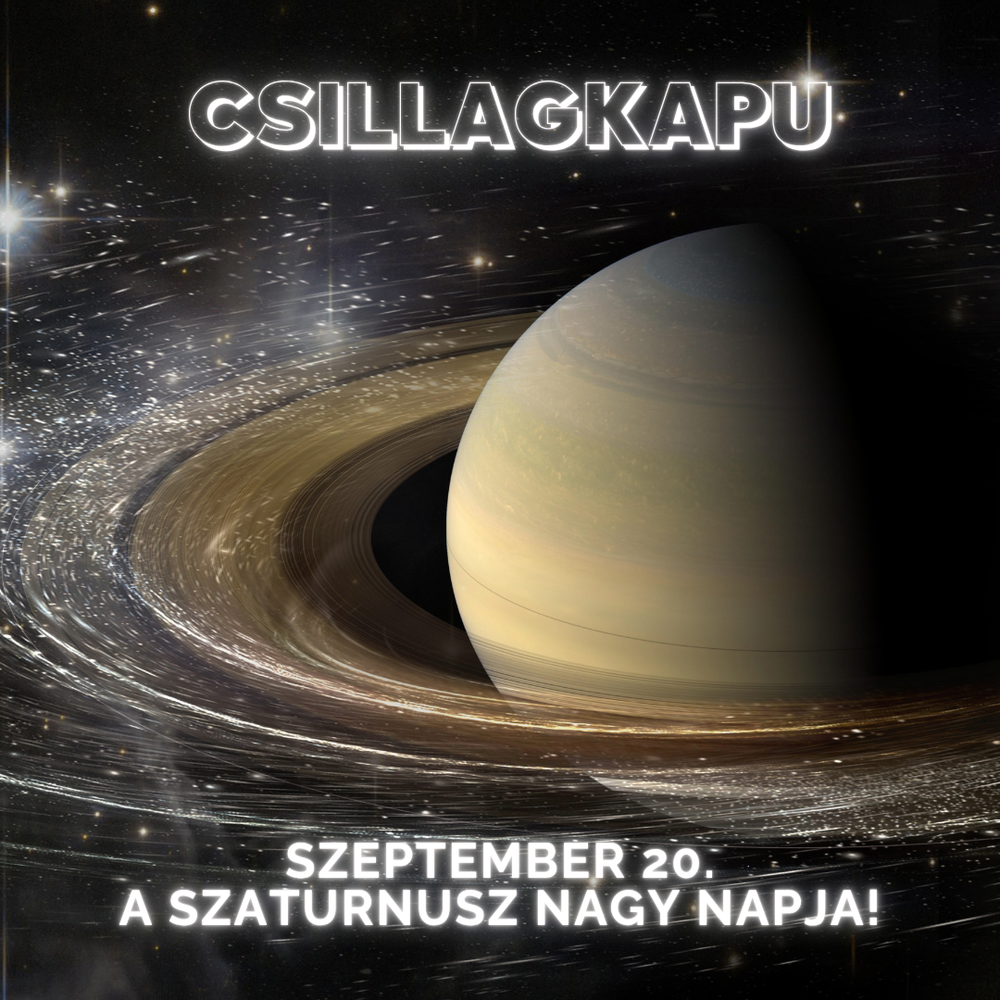
Stargate: Saturn's Big Day! - 09.20.Click to apply

Saturn will be opposite the Sun the following morning. This means that the queen of the planets is now best seen through telescopes. At our bustling Star Gate, we can admire Neptune next to Saturn, as well as the most beautiful star clusters and planetary nebulae in the early autumn sky without moonlight!
In 2025, Saturn's equator will face Earth, so we will now be able to see its rings from edge on. However, it is not only the sight of the razor-thin, sharp rings that is impressive: at this time, we will be able to admire both hemispheres of the flattened planet. Saturn's moons also offer a special spectacle: Rhea emerges from behind the planet and dances across the thin ring, moving further and further away with each passing hour. To its right, we can see the moons Tethys and Dione, and to its left, the orange giant moon Titan! What's more, in the planet sniffing lab, we can even take a whiff of Titan's scent.
Schedule
Stargate: During our major astronomical event, visitors can explore the Svábhegy Observatory program venues freely and at their own pace. It is worth buying tickets online in advance, but tickets can also be purchased on site.
Programs:
Daytime astronomy
Sun observation: early arrivals can admire the sun as it prepares to set during the first half hour of Stargate. With our solar telescopes, we will observe groups of dark sunspots, fountain-like solar flares, and bright, lace-like solar prominences in different colors.
Interactive astronomy programs
Under the spell of rings - a lecture on Saturn and the secrets of its ring system.
Meteorite examination - hold stones from space in your hands!
Spectrum Zone - light experiments in all colors of the rainbow
Planet Sniffing Laboratory - get ready for some serious sniffing!
Comet Cooking - we cook a smoking comet nucleus
Space-Time Trampoline - put the planets into orbit around the Sun!
Telescope Tricks - we take it apart, cut it in half, look inside, focus it...
Nighttime telescope observation
Saturn: We can admire this planet, which rises higher and higher during the evening, from all of our observation sites!
Neptune: The tiny, sea-blue outer planet waves at us from the edge of the solar system.
Glittering globular clusters and open clusters: M13 and M15 globular clusters, the Double Cluster, the Owl Cluster, Captain Hook's Cluster, and the rising Pleiades...
Late summer gas nebulae in the sky: Cygnus Nebula, Ring Nebula, Blue Snowball Nebula...
And last but not least, the Andromeda Galaxy.
In case of cloudy weather: Our Stargate event will take place regardless of the weather, as our interactive program venues are always accessible. In cloudy weather, instead of observing celestial bodies through telescopes, we will offer dome tours, video observations through telescopes, spectroscopic light source observations through telescopes, and themed lectures!
Svábhegyi Observatory of Budapest
"The Svábhegyi Observatory is the largest demonstrational observatory in Budapest also an interactive astronomy experience centre. Our main goal is to bring the beauty of the Universe closer to everyone."