Teréz Szilágyi: Affected Forgetting

Anything can be associated with anything – especially today – yet it is far from irrelevant whether we do this as a statement or as a question. The traditional notion of time, according to which it progresses linearly from past to future, with ourselves situated at its intersection point in the ever-present present, is, according to the French philosopher Henri Bergson, mistaken. If we wish to grasp time in an exact way, Bergson argues, we should not conceive of it in relation to the physical world. For time is primarily internalized time – time as lived and experienced by the individual.
— Ármin Tillmann —
Schedule
Objects, people, and phenomena we encounter throughout our lives are inscribed into our memory; depending on their significance or weightlessness, they either become deeply imprinted or gradually fade away. We may speak of “affected forgetting” when things reveal themselves in their full reality to conscious perception and sensory apprehension, and then settle into a designated place within personal memory, thereby surrendering themselves to the continuous cycle of recollection and forgetting.
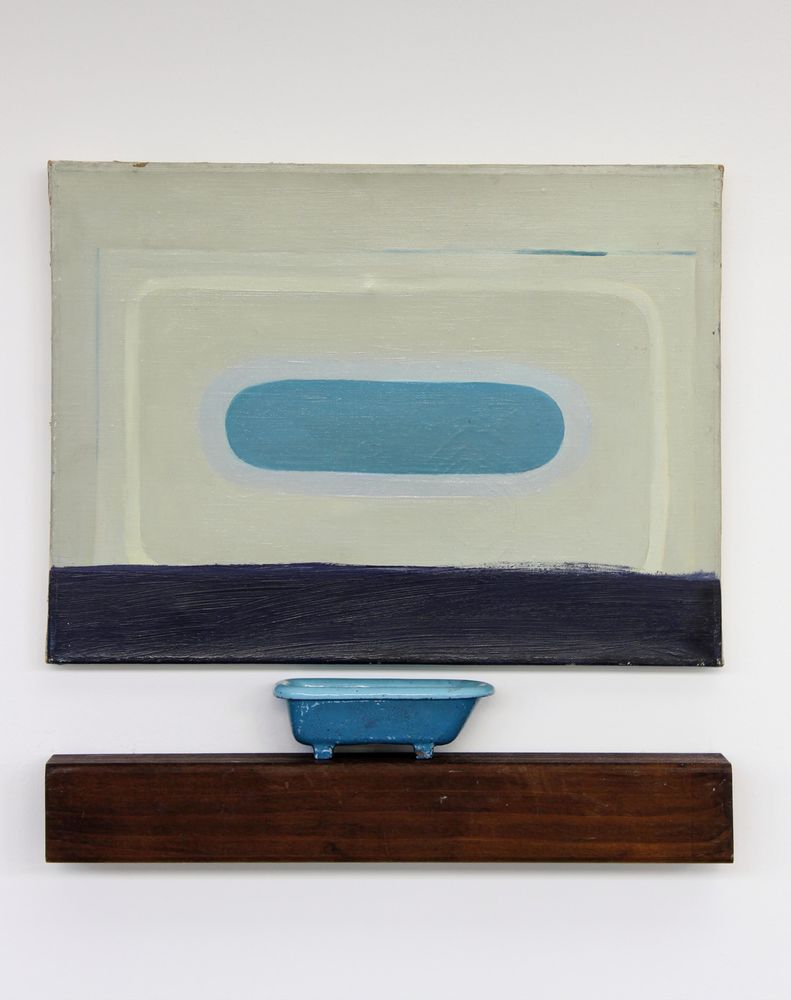
The work Time Held in the Hand was created by Teréz Szilágyi for a joint college exhibition titled The Impossible, or the Struggle for the Objectification of a Concept, held at the Artpool Art Research Center in 2001. Later that same year, she presented the work again at the exhibition space of the Óbuda Society, accompanied by a fragment of text, at which point the title was modified to Time Held in the Hand.
One day, Teréz Szilágyi noticed a miniature bathtub in the window of an antique shop, presumably made for a dollhouse. This originally neutral toy object gradually became, for her, the memory of something that has since become an integral part of her recollection—something she was then able to associate with her painted work on canvas. This tiny bathtub behaved in her memory much like the collective consciousness of the characters in Arundhati Roy’s novel The God of Small Things: “They knew that things could change in a day.” In this way, Szilágyi succeeded in rendering a once intangible memory as a tangible object of remembrance. Returning to Bergson, the philosopher and dance educator Valéria Dienes writes of his early theory of time: “It functions in intimate interweaving with memory, and for this very reason it is always identified with the true persistence of the past, with the single and unrepeatable memory of each of our experiences. […] Our ordinary memory almost always arises from the interplay of the two [bodily memory and the memory of the past].”
Ármin Tillmann
April 7, 2026, Tuesday 18:00 – April 30, Thursday 19:00
The exhibition will be opened by Ármin Tillmann