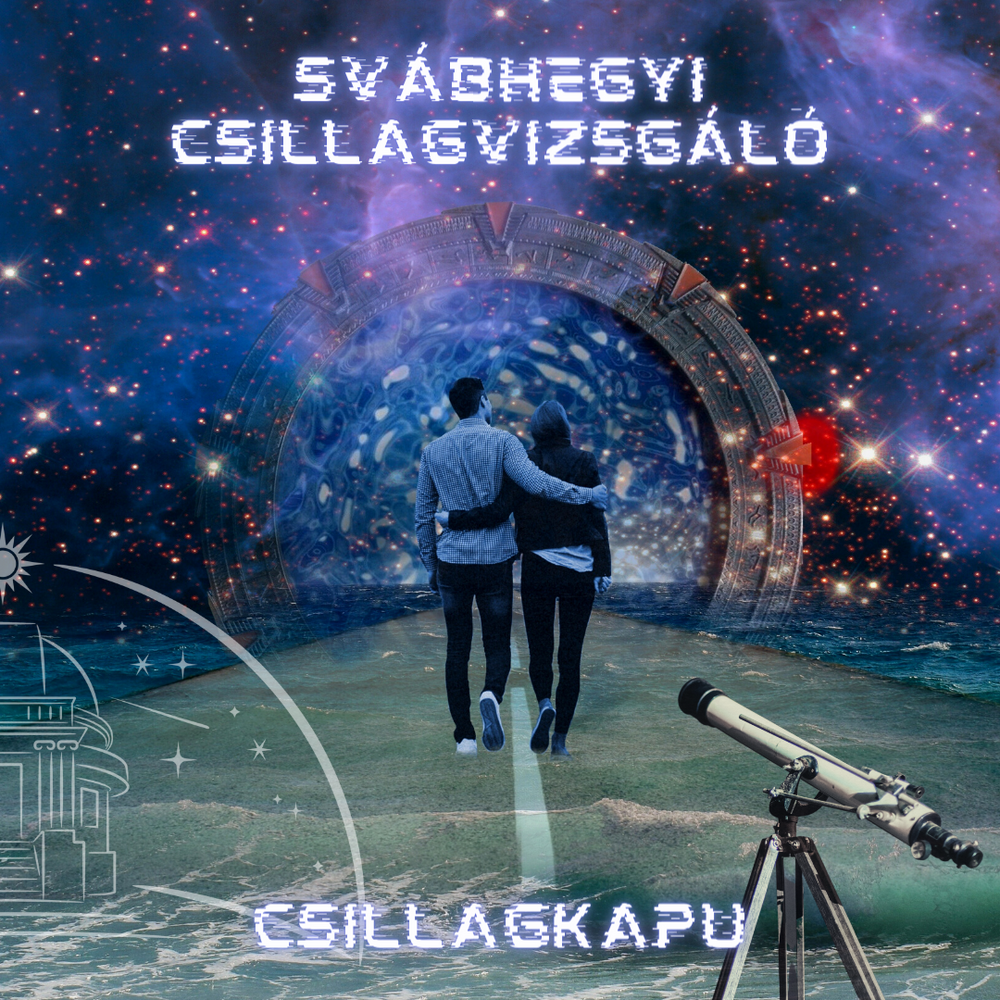
Stargate at the Svábhegyi Observatory! Moon crescent and summer Milky Way

Did you hear that? 'Stargate' opens in the Svábhegyi Observatory!!!!
Always wondered about the stars and the mysteries of the Universe? Svábhegy Observatory will open the door to the infinite curiosity with a new series of events full of endless wonders for everyone! At these pre-announced Saturdays, all the observatory's astronomical program sites are free to explore at your own pace. Families with the curious little stargazers are welcome from the afternoon, with a full range of interactive family activities, while everybody else (who can stay up late :)) can join us any time and stay until 11:00 PM.
If you want to reserve your spot, you can buy your tickets in advance (we recommend it!) however these days you can redeem your tickets on the spot and dive right in the joy of observing.
Tonight's feature is the Summer Milky Way. The central band of our galaxy is home to a multitude of magnificent star clusters, mysterious nebulae, dark dust belts and star clouds. As we wait for darkness to fall, we'll be treated to the pretty, thin crescent of the Moon, Venus's huge and thinning crescent, and even the rarely seen Mercury from the dome!
Schedule
Let's see what we have in store for this afternoon and evening:
17:00-18:30 Daytime Astronomy:
The Stargate opens at 17:00!
The Budapest Dome will host a special daytime planetary survey: We will observe our two inner planets, tiny Mercury, a real observer's treat, and the crescent of the massive Venus!
And at our **Observatory Terrace and Telescope Workshop, **we'll unravel the secrets of our Sun. In our special Hydrogen Alpha Telescopes, we'll see the shapely sunspots on the solar surface and the fountain, flume or bridge-shaped prominences of the solar atmosphere.
18:30-21:30 Moon crescent and the thinning crescent of Venus in the twilight sky:
We'll explore the Moon's crescent in amazing detail during the upcoming evening. In the north, we can admire the shapely craters of Atlas and Hercules, in the Nectaris basin we can admire the rising ruin crater Fracastorius, and in the south we can marvel at the giant crater Janssen and its massive side craters. You can see the Moon until 20:00 in the Budapest Dome, until 21:00 at the Telescope Workshop and until 21:30 at the Observation Terrace. It can be exciting to view from all three locations! Venus' bright crescent, just 13% bright, will also be our target, at the Telescope Workshop and Observation Terrace until 20:00!
17:00-21:00 Interactive activities:
Before dark, we will have a number of scientific, interactive and entertaining programmes closely related to astronomy:
On the Space-Time Trampoline, we will model the movement of planets and stars with the help of speeding marbles.
Meteorite Investigations: we'll be looking into our microscopes to see the rainbow-coloured crystals of meteorites with our own eyes. You can also get your own hands on objects from billions of years of space.
Our Spectrum Zone takes us into a colourful world of light and optical experiments, and shows us exciting things like black flames!
Smell the scents of the planets of the solar system by smelling the 'space perfumes' in the flasks of a planet-sniffing lab! A unique experience, we guarantee it! : )
As evening falls, the starry sky awaits!
21:30-23:00 - evening stargazing
In the darkening twilight sky, we will look at the most beautiful double stars of the summer sky. The red giant star of Ras Algethi, the alpha of the constellation Hercules, will be admired not only for its red colour but also for its yellow companion, which shines close by. We then open **the double double star of Epsilon Lyrae **and admire the orange and blue pair of Albireo, which forms the head of the Swan.
In a moonless summer sky, we can finally take a plunge among the Milky Way's most beautiful star clusters! In the slowly setting summer Milky Way, we'll visit the V-shaped Wild Duck Arrow cluster (M11) of the constellation Shield and rest in the Sagittarius constellation's M25 cluster, which forms a support chair. We'll also visit some of the most beautiful gas nebulae in the central Milky Way: the huge Lagoon Nebula (M8), with its huge, porous lagoon of dust, the graceful-necked Swan Nebula (M17), which forms a bird on the water, and the Eagle Nebula** (M16)**, with its swirling mound of arrows.
Svábhegyi Observatory of Budapest
"The Svábhegyi Observatory is the largest demonstrational observatory in Budapest also an interactive astronomy experience centre. Our main goal is to bring the beauty of the Universe closer to everyone."