The Invisible’s Visible Touch - Márta Kiss & Brigitta B. Horváth

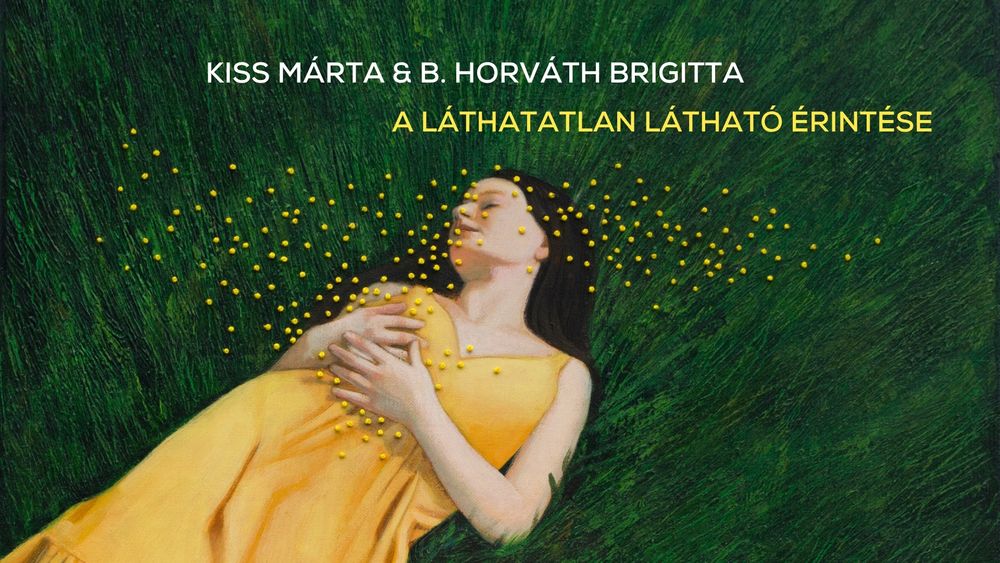
The Invisible’s Visible Touch is a joint exhibition by visual artist Márta Kiss and jewellery and applied artist Brigitta B. Horváth. The exhibition explores different forms of human connection and modes of perception through Márta Kiss’ latest paintings alongside Brigitta B. Horváth’s jewellery, body jewellery, and sculptural works. Although the two artists work in different media, their practices converge through shared inquiries into the invisible relationships that connect the individual to themselves, to others, and to the natural world. Their works approach experiences through the body, memory, gesture, and symbolic meaning, addressing dimensions of human existence that resist the frameworks of rationality and language.
Márta Kiss’ paintings investigate the permeability between inner landscapes and the natural environment. Within her compositions, landscape becomes a carrier of psychological processes and experiences of self-discovery. The figures inhabiting her works often evoke archetypal or mythological characters, serving as mediators of internal states and universal human experiences. Embroidered elements integrated into the painted surface further expand these layers of meaning: the needle piercing the canvas marks the opening of a new dimension, while the thread becomes a metaphor for connection.The networks created through embroidery point to invisible structures that situate humanity, nature, and personal memory within a shared system.
Schedule
A defining focus of Brigitta B. Horváth’s artistic practice is touch, the gestures of the hand, and the body as the primary site of human connection. In her work, jewellery and sculpture function as instruments of communication and self-reflection. The motif of the hand and the experience of touch explore the possibilities of exchange across cultures, identities, and interpersonal relationships. Her recent works place particular emphasis on the relationship between the body and time, presenting the ageing, changing body as a bearer of lived experience. Within this context, jewellery becomes a medium that makes the body's stories visible, redefining beauty through inner content, self-acceptance, and human presence.
The practices of the two artists intersect through their shared interest in visualising connection, perception, and inner experience. In Márta Kiss’ work, thread and embroidery become mediating elements; in Brigitta B. Horváth’s, touch and the gesture of the hand fulfil a similar role, directing attention towards relationships that extend beyond the visible world. Both artists render perceptible phenomena that cannot be directly seen: inner processes, layers of memory, human relationships, and the individual's connection to natural and cultural systems.
Their practices are further united by a shared openness towards self-exploration and by the search for visual languages capable of expressing inner states and layers of meaning that reach beyond personal experience. Both artists work with archetypal motifs, symbolic forms, and images of humanity's relationship with nature, opening individual experience towards broader human contexts.
The Invisible’s Visible Touch attempts to map a domain that is difficult to define - one in which body and nature, individual and collective memory, the visible and the invisible remain in continuous dialogue.
The Space Art Gallery
The Space, which opened in July 2022, is more than just an exhibition venue — it functions simultaneously as a community hub, educational space, and art management centre. Our goal is to create a meeting point between those interested in contemporary art and key figures in the art world — artists, collectors, and curators. We believe that art can also be a communal experience, so alongside exhibitions, we welcome our visitors with lectures, guided tours, discussions, workshops, and other inspiring events.
Our home is located in a unique Art Nouveau building in the heart of Budapest’s 1st district, on Hattyú Street. Built in 1913, the house originally evoked the atmosphere of the turn of the century with its richly decorated towers and elegant details — and although it has undergone many changes over time, it has preserved its character. When stepping through the gate, one might feel as if they have entered a Parisian inner courtyard — the building’s distinctive charm provides the perfect setting for presenting contemporary art.