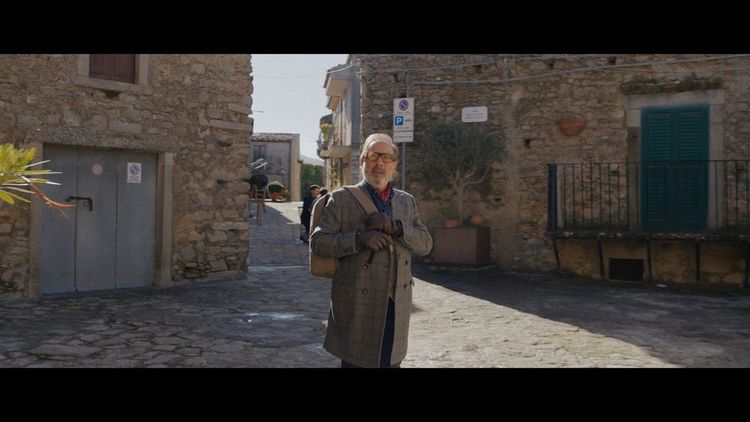
Réka Kaszás | Forms of Absence | Frissen 2026

“I thought I was capable of painting a state of being;
a map of sorrow.
Then, as it turned out, sorrow is by no means a state of being,
but rather a process.
One cannot draw a map of it, only write a story about it”
(C. S. Lewis)2
Réka Kaszás creates her panel paintings using traditional painting techniques. The genre of landscape painting occupies a prominent place in her art. However, she does not seek to reproduce the visual appearance of the landscape; rather, she is concerned with creating a new visual system in which she rearranges the observed reality. She has explored the traditional visual representation of the landscape from various angles in order to find contemporary solutions for the genre. His creative method is characterised by the convergence of observational, analytical painting and a reductive or abstracting approach. From the very beginning of his career, he has thought in terms of systems; thus, in his earlier series of paintings, he always examined nature and the man-made, built environment in terms of their mutual influence. In the series entitled ‘Variety’, he depicted human structures as abstract forms, juxtaposing them with organic forms drawn from nature, such as clouds. In the series entitled ‘Dissolving Reality’, he used the independent movement of the paint as it dripped to construct or, indeed, deconstruct the image. For him, the aim is not the precise reproduction of observed reality, but rather the experience of the landscape, the observation of the moment and the location; as he puts it: in this way, whilst creating, ‘the landscape also passes through me’.3
In his collection of essays on the genre of landscape painting and its contemporary possibilities, Zoltán Somhegyi, paraphrasing Ernst H. Gombrich, writes: ‘landscape painting does not actually exist; there are only landscapes’. 4 He then poses some extremely useful questions regarding the genre, such as: what must appear in the picture for us to consider it a landscape?5 Somhegyi thoroughly examines the possible ramifications of this genre, and these ideas are certainly helpful when analysing Réka Kaszás’s paintings. What makes a contemporary interpretation of Kaszás’s landscapes possible is precisely the fact that elements taken from the landscape, or landscape-like elements, constitute only a part of the painting’s overall composition. In other words, as genre elements, they take on the role of motifs, thereby replacing memories.
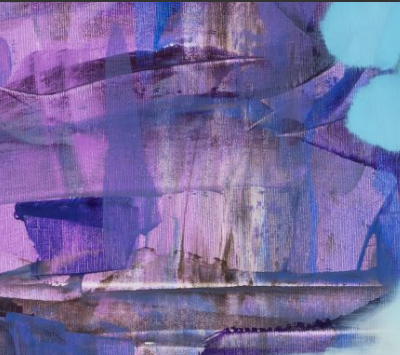
The paintings the artist created for this exhibition are composed of several layers. The first is a layer of gestural painting. The opaque, semi-opaque and glazed, translucent layers of acrylic paint applied to the white canvas provide a kind of free, emotionally charged painterly foundation. The artist then paints around this gestural layer with extreme precision using a single-colour, opaque acrylic paint of uniform consistency. In this way, the gesture itself takes on the role of a quotation, whilst also creating the impression that it is emerging from this monochrome base. The size of the gesture is also significant: it carries meaning for the artist, as it represents the area that can be ‘encompassed in a single movement’. As a third layer, a delicate, representational layer of oil paint is applied to the surface of the gesture—or rather, emerges from it. This might be a landscape with easily recognisable details, a vast expanse of sky with street lamps alongside a country road, or a cityscape emerging from behind trees, featuring houses and a bridge. But it could also be a paraphrase from art history (for example, a detail from a painting by Károly Markó), or the combined depiction of specific landscape elements and living creatures, such as a cat, the figure of a Venetian gondolier, or a recognisable section of a gate. At the same time, the landscape that emerges within the field created by this gesture functions far more as a visual element that aids memory than as an independent visual subject.
The deliberate composition of these images also helps us to understand the processes of thought, and by visually evoking memories, it assists us in coming to terms with the past. Just as the layers build upon one another in the picture – that is, just as the artist, through a gesture, opens a ‘window’ through which a figurative field of imagery is revealed – so too can we summon our memories from that imagined place within the abstract field where we store them, where they lie hidden. The choice of colour is also deliberate, as the gestural field or movement of colour is composed of hues that lend it an almost psychedelic power; and because they consist of multiple colours, these also refer individually to that part of the mind from which we summon the images of memory. Thus, the analytical, synthesising and abstracting levels of mental processes are all revealed in Réka Kaszás’s latest paintings.
The title of the exhibition is *Forms of Absence*, which applies equally to the formal solutions, the content of the paintings and the artist’s personal motivation. In Kaszás’s latest paintings, absence signifies not only a physical absence but also the acceptance of a new life situation. The earlier landscapes, which once filled the entire canvas, thus become details of a landscape flashing across a field of gesture; they obscure part of the gesture whilst losing their own full extent. Consequently, it too becomes, in terms of content, a fleeting glimpse – details of landscapes that we think we recognise, but whose fragmentary nature means that, rather than precise identification, we are content with the experience of recognition.
The artist created the latest paintings on display at the exhibition to explore the theme of absence. Just as C. S. Lewis, in the motto chosen for this text, speaks of a process in relation to understanding grief, so too do these paintings, as a kind of descriptive process, unravel the memories encapsulated in visual signs and help us to absorb them.
Mária Kondor-Szilágyi, curator
Schedule
///////
Building on the ideas of Daniel Arasse, the 2026 Frissen exhibition explores the Renaissance thesis that a work of art inevitably reflects the individuality of its creator. Although the death of painting has been predicted on numerous occasions since the advent of photography, as well as from the perspective of critiques of capitalism, the genre has always been revitalised and strengthened through aesthetic and social self-reflection. The Műcsarnok’s seventh ‘one artist – one room – one curator’ exhibition seeks to answer the question of why artists paint today. This collection of personal exhibitions showcases the diversity of the profession through the latest abstract and figurative works by six Hungarian contemporary painters, brought directly from their studios.
Artist–curator pairs: Ákos Bánki and Szilvia Reischl, Réka Kaszás and Mária Kondor-Szilágyi, Gábor Király and Gréta Garami, Kata Könyv and Réka Fazakas, Tamás Menyhárt and Zoltán Rockenbauer, Katalin Verebics and Anna Blanka Nagy
Kunsthalle Budapest
The largest exhibition hall in Budapest, in Heroes Square, just the opposite the Museum of Fine Arts.