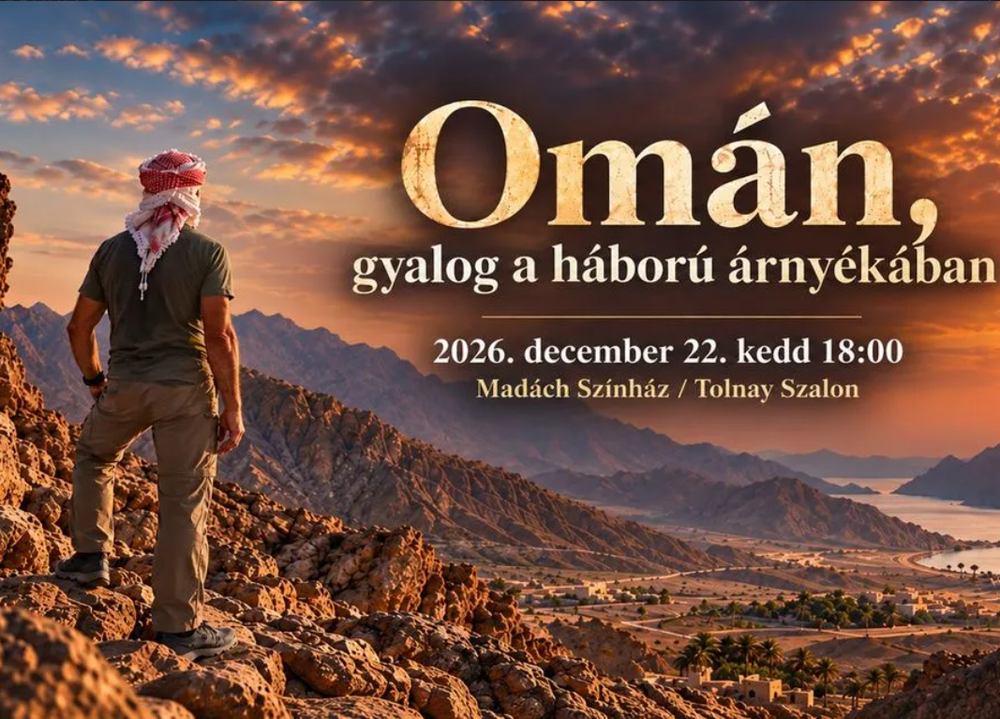
Oman—On Foot in the Shadow of War

“In 2021, I walked from the Syrian border all the way to the Saudi Arabian border, to the shores of the Red Sea. I spent weeks alone in the Middle East—in the desert, in the mountains, as a guest of the Bedouins—and I returned home knowing that one day I would like to go back.” Camino Steve
Schedule
"This time, I’m inviting you to a performance whose ending even I don’t know yet.
In 2021, I walked from the Syrian border all the way to the Saudi Arabian border, to the shores of the Red Sea. I spent weeks alone in the Middle East—in the desert, among the mountains, as a guest of the Bedouins—and I returned home knowing that one day I would like to go back.
Since then, however, the world has changed. There was the terrorist attack in Israel on October 7, 2023, the war in Gaza, the conflict in the West Bank, the fighting in Lebanon, and then the armed conflict between the U.S., Israel, and Iran. Because of all this, the possibility of returning has grown more distant for me with each passing year. But I’ve decided that, despite all this, I won’t wait any longer—I’m going back anyway. To Oman.
John Edwards, an English petroleum engineer, lived in Oman for 16 years. He connected centuries-old and millennia-old, partly abandoned donkey caravan trails, footpaths, and mountain villages into a single long-distance route, thereby creating the Arabian Peninsula’s first long-distance hiking trail by 2020. One section of the trail—an old donkey trail—is connected, for example, to a trade route that is about 3,000 years old. As for certain parts of the final seven days of the route, it’s likely that no one other than the local semi-nomadic Shawawiya herders has ever walked them before. I’m going to give it a try now.
I plan to spend nearly a month on the trails of Oman, walking about 550 kilometers—and, if conditions permit, even more.
My journey takes me through the rocky landscape of the Hajar Mountains. Mountains nearly 3,000 meters high, abandoned trails, deep wadis, and stretches where there are no settlements, no roads, and not even tourist signs to show the way forward await me. Where water isn’t simply a matter of comfort, but one of the most important aspects of daily planning—and, above all, survival. In a single day, I can go from 36 degrees of desert heat to nights near freezing, and where a bone-dry wadi can turn into a raging torrent in a matter of minutes if the sky opens up somewhere high up in the mountains. This time, too, I don’t know what awaits me, since this isn’t a well-marked route that many people have completed. About 100–200 hikers have traveled this route so far, but most of them have only covered one or two sections.
I don’t know if I’ll be able to accomplish everything I’ve planned. I don’t know how many kilometers I’ll end up covering. I don’t know when the route, the weather, or the security situation in the region will force me to change my plans in a country that the President of the United States recently threatened to bomb. By December 22, we’ll know how my story ends.
I’ll talk about the beauty of Oman’s mountains and deserts, and about the people I meet along the way. I’ll share what it feels like to set out on a journey where, once again, I can only count on myself—especially in a country living in the shadow of war.
But I’d like us to talk about something else this evening as well! We’re meeting just a few days before Christmas. After the performance, we’ll go home to our families, decorate the tree, sit down at the holiday table, and perhaps shut out the outside world for a few days. Meanwhile, not so far from us, for millions of people—regardless of religion, nationality, or which side of a border they live on—this evening will mean something entirely different.
Perhaps that’s why it’s worth setting out on a journey sometimes. Because traveling not only shows us how vast and colorful the world is, but also how many things in our lives we take for granted—even though they certainly aren’t. Safety, home, family, and above all, peace.
Come along so you can discover my story—a story whose ending even I don’t know yet!"
Camino Steve
Madách Theater
There is still an “era” in the Madách Theater. The era of the rise and success of musical theater. The change began in 1983 with Cats, whose decades-long series of success provided a solid foundation for the next defining step: the legendary 2003 performance of The Phantom of the Opera. Both performances were directed by Tamás Szirtes, who was elected director of the Madách Theater in 2004. Under his direction, the Madách Theater embarked on a path that has resulted in a successful musical theater of outstanding quality. World-famous musicals line up in his program, which are usually in large blocks, so-called they are staged according to the en suite playing order, and each performance remains on the show for years. The basic aim of the theater is to give the viewer the same experience even after 10 years as at the premiere.