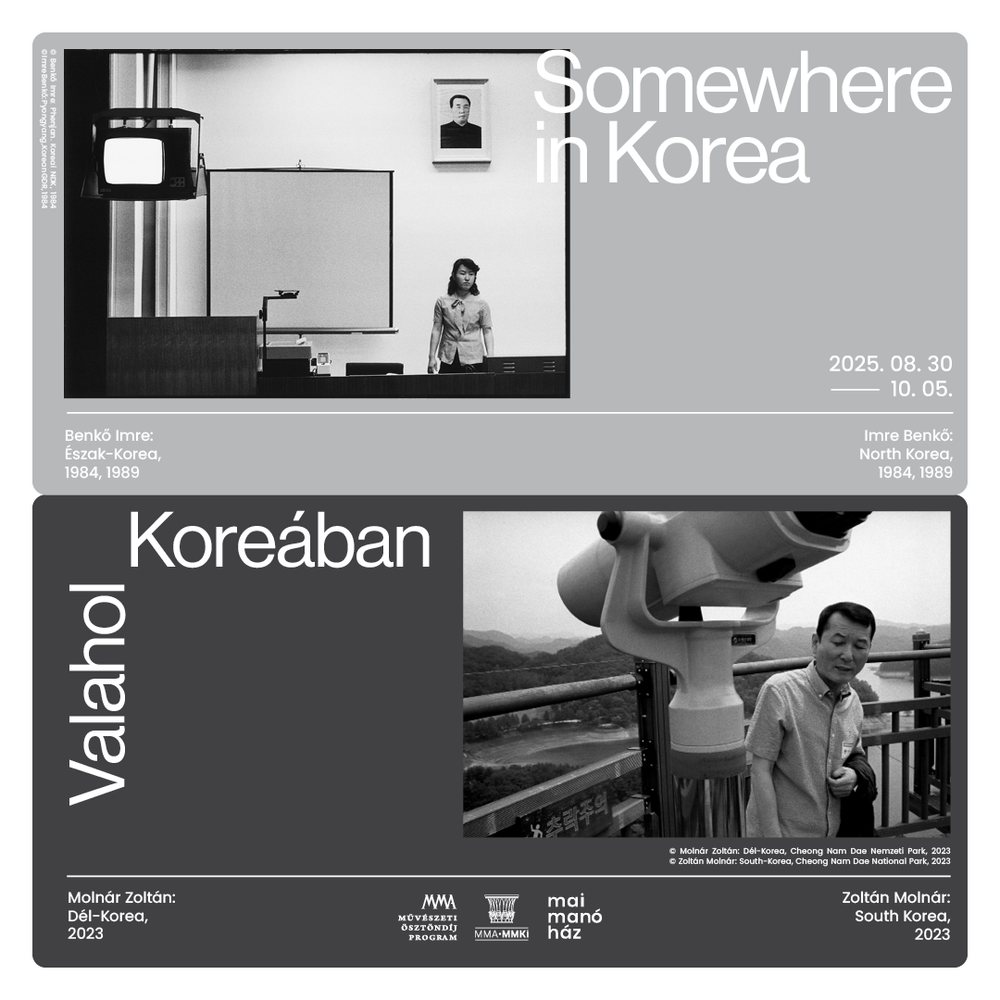
SOMEWHERE IN KOREA. ZOLTÁN MOLNÁR: SOUTH KOREA, 2023 – IMRE BENKŐ: NORTH KOREA, 1984, 1989

The exhibition is open to the public:
30 August 2025 – 5 October 2025
Tuesday – Sunday from 12 to 7 pm
Closed on Mondays and public holidays
Curator: Péter Baki
Opening: 29 August 2025, Friday, 6 pm
Opening speech by Zsuzsanna Tulipán, art historian
Imre Benkő (1943–) and Zoltán Molnár (1973–) are indispensable figures in contemporary Hungarian documentary photography. Their paths crossed at one point during their careers, and they have maintained a close friendship ever since. The history of Hungarian photography, stretching back to the 19th century, features several teacher-student relationships that often developed into mentor-apprentice dynamics. However, the connection between these two photographers has never eclipsed their autonomous work. Imre Benkő’s strong visual presence is evident wherever Zoltán Molnár travels, but it does not overshadow Zoltán Molnár's current projects. Today, we see two documentary photographers with fully developed visual styles. Both are drawn to the Far East. Benkő continues to explore the major cities of China, while Molnár has found a profound attraction to South Korean culture, which captivates him both visually and spiritually. This personal commitment is crucial for creating any internationally acclaimed photo series.
Schedule
Imre Benkő first traveled to North Korea as a tourist in 1984. Within the limits allowed to him, he documented certain segments of the country, which was already operating as a dictatorship at the time. Naturally, he could only capture what he was permitted to, as he was not allowed to travel freely, and his subjects and visual choices were closely monitored while taking photos. In 1989, he returned to Pyongyang as a photojournalist for Képes 7 magazine, where he documented the events of the largest World Festival of Youth and Students. Alongside the “expected” images, however, he also created works that reflected his own visual style—images that convey a sense of timelessness, both within his own body of work and in relation to the North Korean context.
Zoltán Molnár's photographic vision shares similarities with that of his former university professor, particularly in terms of his intentions and moral foundations. His work demonstrates the visual quality of truly outstanding travel photographers. Rather than simply focusing on the interesting or exotic aspects of a location, he filters his experiences through his own perspective, creating personal interpretations. For him, too, it is not just a place's geographical or political distinctiveness that makes it worthy of presentation.
In the works of travel photographers Imre Benkő and Zoltán Molnár, one can discern a personal evolution that unfolds through inner journeys, accompanied by a refined visual world that emphasizes the experiences of others. Although each follows their own artistic direction, the two series nevertheless connect the spiritual roots of North and South Korea, revealing deeper parallels between the two countries that may initially seem distant or unrelated.
Suggested time to visit the exhibition: 30‒50 min.
Mai Manó House is not barrier-free.
Tickets for the exhibition can only be purchased in person at the venue, as online ticket sales are not available.
Hungarian House of Photography - Mai Manó House
Mai Manó House – The Hungarian House of Photographers – operates in a studio-house built at the end of 19th century, for the commission of Mai Manó (1855-1917), Imperial and Royal Court Photographer. This special, eight-story neo-renaissance monument is unique in world architecture: we have no knowledge of any other intact turn-of-the-century studiohouse. In addition, it serves its original goal, the case of photography again.
The aim of Mai Manó House is to advance the development of Hungarian photography and raise photography’s national prestige as a distinct form of art.
The institution plays a marked role in the cultural life of Budapest and Hungary, while the organization of exhibitions and programs abroad is getting more and more emphasis within its activities. The reputation of justly world-famous Hungarian photographers of the 20th century offers a great opportunity to regain our old status in the world of photography by the introduction of the generations following those great masters