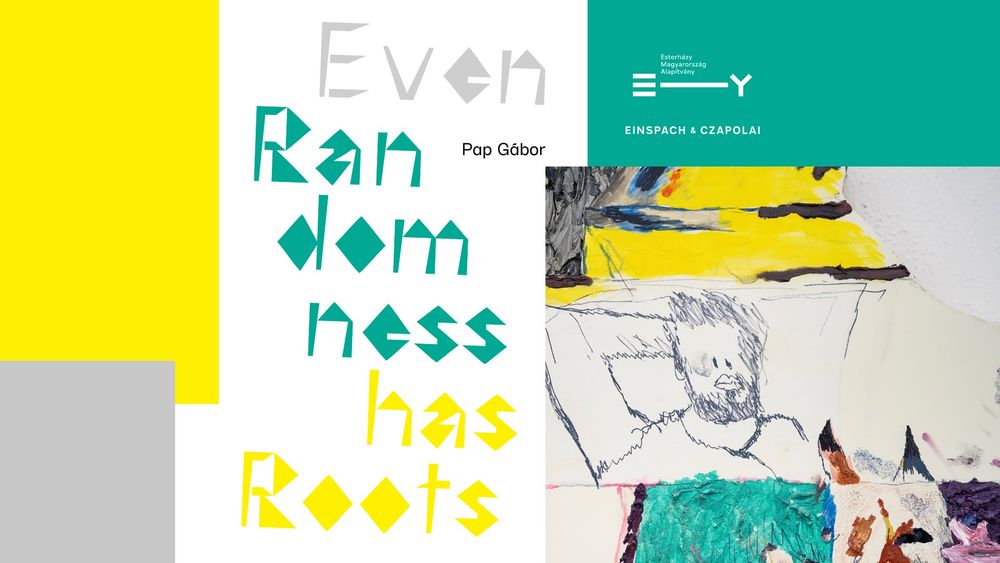
Pap Gábor // Even Randomness has Roots

Schedule
Gábor Pap // Even Randomness has Roots
Opening: 3 September 2026, 6 pm
Opening remarks by: Dávid Fehér, art historian
Presented by Einspach & Czapolai Gallery with the support of the Esterházy Privatstiftung and the Esterházy Hungary Foundation, Even Randomness Has Roots (Auch der Zufall hat Wurzeln) reflects – through the language of contemporary art – on a selection of outstanding objects from the treasury of Esterházy Castle in Forchtenstein. Perched on a spur of the Rosalia Mountains in Burgenland, the castle’s renowned Kunst- und Wunderkammer is one of the oldest surviving curiosity cabinets from the early modern period to have remained largely intact in its original setting.
The earliest known inventory of the collection was compiled in 1654, following the death of Palatine Miklós Esterházy. At that time, it listed only thirteen chests containing family heirlooms and a small number of remarkable objects. After his father’s death, Pál Esterházy continued to expand the collection. Initially, however, the accumulation of treasures lacked a clearly defined concept and primarily served the purposes of aristocratic representation. At the same time, his activities as a collector reflected his erudition, intellectual curiosity, and openness to the wider world. Thanks to his ambitious patronage, the treasury at Forchtenstein grew to encompass an extraordinary range of works of fine and decorative art, rare books and manuscripts, historical weapons, and countless curiosities. Rather than a conventional art collection, it resembled an encyclopaedia assembled through objects. Alongside jewellery, paintings, sculptures, and musical instruments, it included natural rarities, minerals, taxidermied animals, and exotic botanical and zoological specimens gathered from across the globe.
It was also during Pál Esterházy’s lifetime that a monumental system of cabinets, drawers, and storage units was created – a sophisticated display structure in which objects dating from the sixteenth to the nineteenth centuries can still be seen in their original locations today. In 1695, Pál Esterházy designated the collection as an entailed family estate (fideicommissum), ensuring that the treasures of Forchtenstein would remain the inalienable property of the Esterházy family, a status they retain to this day. Established in the seventeenth century by Miklós Esterházy and further developed by his son Pál, the Kunst- und Wunderkammer – particularly when considered together with its unparalleled armoury – remains one of Europe’s most significant surviving cabinets of curiosities preserved in situ. Under Pál Esterházy’s patronage, Baroque ideals of aristocratic representation became increasingly intertwined with systematic collecting and sustained artistic patronage.
Upon curatorial invitation, artist Gábor Pap (b. 1991), whose practice explores material culture, visual association, and the contemporary reinterpretation of cultural meanings, has taken a selection of objects from the Forchtenstein Wunderkammer as the point of departure for his artistic investigation. In the Budapest gallery historical artefacts are presented alongside Pap’s works in a newly constructed network of relationships. Rather than functioning as illustrations of the historical objects, his latest compositions enter into dialogue with them as contemporary responses, opening up new layers of meaning between the historic collection and present-day artistic practice. The exhibition includes a number of exceptional objects, among them leather cases originally used for transporting works of art and a sixteenth-century narwhal tusk, once believed to possess aphrodisiac properties. Pap’s reflections also engage with richly ornamented spears, cannonballs made of limestone, iron, and marble, as well as intricately carved gunstocks (Gewehrschaft).
The exhibition’s central ambition is to place Gábor Pap’s contemporary works and the historical objects of the Forchtenstein Wunderkammer within a shared interpretative framework. The dialogue between historical and contemporary works also embodies the guiding principle of the Esterházy Art Echo initiative: the continual reinterpretation of the relationships between past and present, historical heritage, and contemporary artistic practice. With this programme, the Esterházy Hungary Foundation continues the historic patronage tradition of the Esterházy family while simultaneously activating the family’s cross-border cultural legacy throughout the Pannonian region.
At first glance, a Wunderkammer may appear to be little more than a random assemblage of disparate objects. In reality, however, it represents one of the earliest and most compelling attempts to impose order on the world and to understand its complexity. In this sense, the exhibition does more than juxtapose historical artefacts with contemporary works of art; it interrogates the very logic of collecting itself. Beneath what may seem to be accidental connections lie deeper cultural, historical, and conceptual relationships. The title Even Randomness Has Roots therefore functions not merely as the exhibition’s motto but as its central proposition: the order of things is never self-evident, but is always the product of a particular worldview, a mode of knowledge, and a system of interpretation. The exhibition offers a contemporary reimagining of this historical model of knowledge, in which objects from the past and the visual thinking of the present come together to generate new constellations of meaning.
Mónika Zsikla